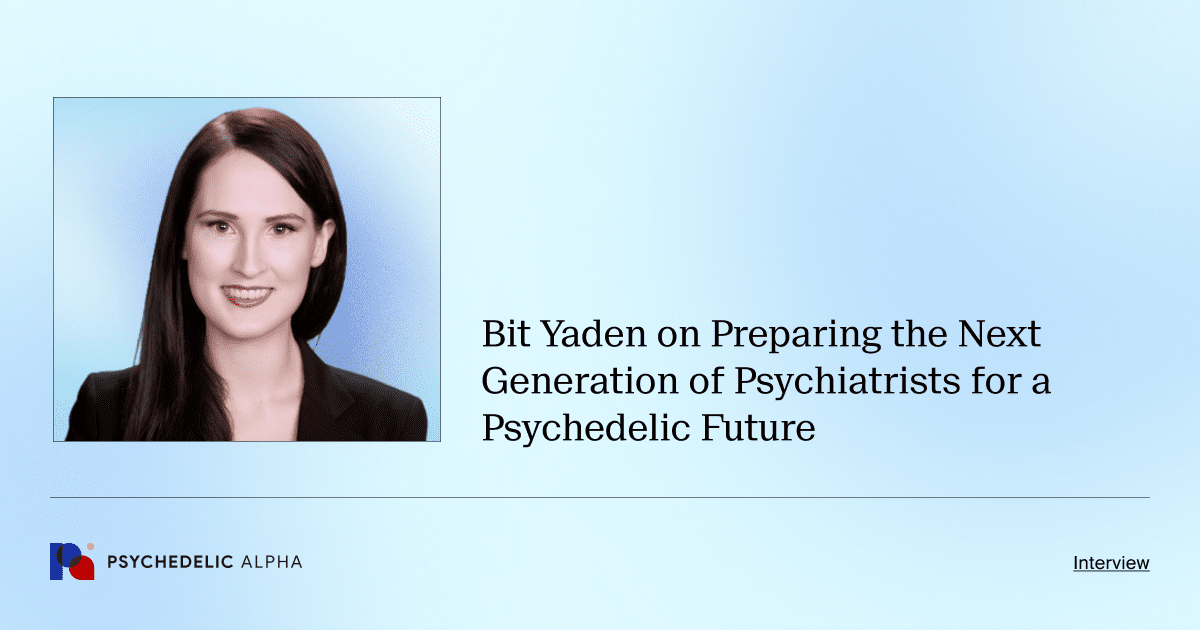
Bit Yaden on Preparing the Next Generation of Psychiatrists for a Psychedelic Future
Dr. Mary Elizabeth “Bit” Yaden is an assistant professor in the Department of Psychiatry and Behavioural Sciences at Johns Hopkins University and the clinical director of the Center for Psychedelics and Consciousness Research (CPCR). She currently helps lead a multi‑institutional project to teach psychedelic medicine to resident psychiatrists at programs including John Hopkins, NYU, Penn, and Yale—work that forms the basis of her conversation here with Psychedelic Alpha editor Josh Hardman.
Our question was: From a safety standpoint, what is essential for me to know as a prescriber? And that question hadn’t been asked nearly as much as you’d expect.
Josh Hardman, Psychedelic Alpha: Perhaps you could start by telling us about the educational project you’re part of.
Dr. Mary Elizabeth “Bit” Yaden: I think my favourite part of this educational project is that we’ve brought together eleven medical educators who were already in the psychedelic world—several of whom were either primary educators or principal investigators at psychedelic centres. We received grant funding from the Heffter Research Institute specifically to start thinking about how to teach psychedelic medicine within a traditional psychiatric context.
Our group includes Terence Ching, Ben Kelmendi, Chris Pittenger, Steve Ross, Natalie Gukasyan, Kelley O’Donnell, Dan Roberts, Noam Goldway, Gianni Glick, Jamila Hokanson. If I have one mission, it’s to celebrate these wonderful people in psychiatry and psychedelic education.
Over about two and a half years, we met regularly to ask a very simple but surprisingly under‑examined question: What is the most important thing future psychiatrists—or prescribers more broadly—need to know? And we focused on resident psychiatrists because they’re the ones who are most likely to become the future clinical leaders in psychedelic medicine.
Our question was: From a safety standpoint, what is essential for me to know as a prescriber? And that question hadn’t been asked nearly as much as you’d expect.
We brought together people from three of the U.S. institutions with the deepest experience in psychedelic medicine and got them to agree on what the most important information really is.
Hardman: What are the main areas you’re focusing on?
Yaden: We started with a broad overview of the field—essentially trying to map out why we’re here talking about psychedelics in the first place.
Psilocybin, MDMA, and ketamine were the three medicines we focused on, because we figured that if we’re speaking to people who may be prescribing these in the future, these are the ones that are most likely to be relevant.
We also had a lecture dedicated to equity and inclusion within psychedelic medicine. Terence Ching really led the way on that one. We wanted to emphasise that this kind of treatment is fundamentally about creating safety, and so we really wanted to be genuinely thoughtful about these issues from the start.
The end of the course shifts into the very concrete safety considerations. What are the drug–drug interactions? How do you appreciate that psilocybin is not MDMA and not ketamine? There’s a tendency to conflate these medications because the treatment model can look similar, but clinically they’re very different in terms of how I would monitor someone as a physician or provider.
And then we wanted to get into the practicalities: if a patient comes to you with a question, what do you actually say? How do you counsel people ethically and appropriately if they’re planning to do this, or if a loved one has already done it? How do you handle adverse events—because they do happen, and you need to be prepared—and how do you screen for risk in a way that’s responsible?
I think these are the topics that often go unsung in other training programs. They’re especially relevant for psychiatrists and other medical providers who are doing the screening as well as counselling potential patients or research participants.
Hardman: Are you looking to reach psychiatrists who are already familiar with Spravato and are likely to integrate psychedelics into their offering? Or is it more the rank‑and‑file psychiatrist who’s a bit more agnostic?
Yaden: The latter is the idea. We did not create a course for psychedelic enthusiasts. We created a course that, in our vision, could be picked up by any medical school across the country.
We wanted to present a really balanced perspective on a field that most of psychiatry, and most of medicine, is still pretty suspicious of. And we wanted to do it in a way that didn’t inflate the hype, but also gave the field its due and acknowledged, ‘Look, this is another treatment that likely belongs within traditional psychiatry, but we’re still learning about it.
So it was really about saying: here’s what we know, here’s what we don’t know yet, and here’s what you should be aware of when you’re talking to your patients.
Hardman: I’m assuming a big part of it is classroom‑based learning, and then some portion is practicum?
Yaden: Right, and it’s genuinely great psychotherapy education.
Psychotherapy is notoriously hard to teach, and it can feel awkward to receive supervision without someone witnessing your interactions. One of the things I love most is that psychedelic medicine and facilitation, at least in its current form, is dyadic. You have this built-in opportunity to observe and model for your learners in a way that just isn’t possible in most other psychotherapy formats.
It’s different when you’re actually in the room and can say, ‘Hey, I noticed in this moment you did X.’ There’s just a different kind of opportunity there.
So far, Penn, NYU, Hopkins, and Yale have all received at least the didactic portion, and at NYU, Yale, and Hopkins, we’re really trying to get people into the rooms. It’s not automatic; it’s something we have to be thoughtful and selective about. But we’ve now had a number of trainees at Hopkins who we’ve been able to bring through and I think it’s amazing.
It’s such a powerful thing to learn, and it’s different from other areas of psychiatry.
There are just so many people who are going to be talking to their patients about this. The number of patients who ask me about ketamine or psilocybin is enormous.
Hardman: In terms of numbers, where are you at right now? And then looking ahead, say psilocybin were approved early next year, how many psychiatrists would you ideally want to be reaching?
Yaden: The vision for the initial curriculum was really about carving out space for psychedelic medicine within a very conservative educational system, and creating solid, evidence‑based content that institutions could actually use.
Residency cohorts are small—usually ten to twelve people—and we’ve worked with four institutions so far, so in total it’s probably around forty to fifty trainees. We have data on a portion of them, which we haven’t analysed yet, but we’re hoping to write that up soon. That was always the modest initial goal. The next step is really figuring out how we partner with other institutions and even build toward a future clinical fellowship program, which is our moonshot.
And the bigger question—the one I’m spending most of my time thinking about right now—is, if psilocybin really does come to market next year, how many providers of all different credentials—residents, psychiatrists, nurse practitioners—are suddenly going to be in the position I’ve had the privilege of being in for the last several years, actually prescribing and monitoring psilocybin sessions?
And how do we teach them as much as they need to know to do this safely and responsibly? And how do we do it quickly? That’s the part I’m really sitting with.
One of the vehicles we’re thinking about is continuing medical education (CME). NYU already has a course, and we’re developing similar options. The big idea is to create courses that any licensed provider, regardless of credential, can take.
We’re creating these CME courses now, and we launched our first day in March with a plan for a subsequent date in October. We are hoping to build more comprehensive trainings, which is both exciting and a little daunting, but it feels important
There are just so many people who are going to be talking to their patients about this. The number of patients who ask me about ketamine or psilocybin is enormous. And this gives us a way to say, ‘Here’s what we actually know about psilocybin. Here’s where we genuinely need to be cautious. And here’s the legitimate reason to be optimistic.’
Hardman: Is there, in the future, some kind of accelerated path for people who already work with ketamine or TMS, for example, who just need to learn the specifics of psilocybin, rather than starting from scratch?
Yaden: That’s the reason we started the CME journey. How do we take our initial course and turn it into a one‑day training that’s really about psilocybin and psychedelic care—something that gives the basics in a way that’s appropriate for everyone?
I think the goal with the next courses we’re launching is to speak to both of those cohorts: an introductory track for people who just want to understand the basic language of psychedelic medicine, and another for folks who already have experience with the treatment model and are thinking more concretely about providing direct care.
Psychiatry has so many tools, and psychedelics are going to be one of them. We should legitimise that, make space for it, talk about it.
Hardman: Is there anything else you wanted to share about the residency education program?
Yaden: In summary, I think the strength of the resident curriculum has really been the people who contributed to it; the wonderful humans who are thinking critically about a very specific mission: how do we meaningfully shape resident education? How do we give emerging psychiatrists a space to understand the basics and foundations of psychedelic medicine, knowing they’ll be our future prescribers? It’s a wonderful course, and we’re hoping to keep building it, launching it, and bringing it forward.
And then, in terms of CME, it’s just a really exciting time. It’s something our centre is genuinely passionate about, and I think this next phase of psychedelic education is going to be fascinating. We had this big wave of focus on therapists, and now it feels like the moment to acknowledge that there are other people who need to be part of these teams—and some of that is biomedical. It’s less cool and fashionable, but it’s important.
Psychiatry has so many tools, and psychedelics are going to be one of them. We should legitimise that, make space for it, talk about it. But we also do patients a disservice if we act like this is the only thing that could ever help them. Psychiatry has much more to offer than just psychedelic medicine.
Join thousands of psychedelics insiders
Get the weekly psychedelic medicine briefing.
A free weekly digest covering trials, regulation, policy, and access.
By signing up, you agree to our privacy policy. You can unsubscribe at any time.