From Sonora to Big Pharma: Kimon de Greef Traces the Strange Rise of 5-MeO-DMT
Kimon de Greef is no stranger to underground economies, having spent years reporting on abalone poaching (Poacher) and other lesser-examined biotrades. Over the past half-decade, the South African journalist has trained that same analytical eye on 5-MeO-DMT, the potent and short-acting psychedelic, culminating in his latest narrative non-fiction book, published today, Ego Trip.
The result is a deeply-reported account of the history, mythology and economy, surrounding the Sonoran Desert toad and the ‘God molecule’ its venom contains. De Greef traces the rise and unravelling of Octavio Rettig, a Mexican doctor turned toad evangelist-entrepreneur who has attracted both critics and devotees. He pulls on another thread, too: the 21st century push to bring 5-MeO-DMT into Western medicine via intensely competitive drug development pushes, an endeavour that has only accelerated since he submitted his manuscript.
It’s a fascinating read, full of fresh stories, angles, and anecdotes, a testament to de Greef’s rich field work and reporting, but also to the peculiarity of the molecule and the poachers, pharma execs, and seekers that are in its orbit.
Josh Hardman, Psychedelic Alpha: Why did you decide to embark on a book project about 5-MeO-DMT?
Kimon de Greef: In 2020 I was alerted to the phenomenon of toad smoking by a gentleman named Alfred Savinelli, who claimed that he was the originator of the practice.
He was also a wholesaler of white sage, which was something I was reporting on at the time. He said, “I’m surprised you’re not asking me about toad smoking.” I was like, “Me too; tell me more!”
He said he had invented this practice, and that there was a whole Vice documentary about him, which is true. But they then had to produce another documentary when the actual guy who discovered that you could smoke toad came forward.
Then I found out that there is this world of toad poaching. My background is in conservation and ecology, and I’ve done lots of reporting on illicit economies, and I just thought that sounded fascinatingly dissonant. That this substance that was said to give people such sort of transcendent and divine experiences, and often made them feel very connected to the universe and to nature, was potentially being obtained in darker circumstances.
I started reporting on what I thought would be a short article, and ended up coming across a story that involved the two most prominent figures, these men who had evangelised the practice and made it more mainstream.
Hardman: One of those is Octavio Rettig, right?
De Greef: That’s right. Octavio is a Mexican doctor who had this irresistible story of healing himself of crack cocaine addiction using toad, then healing a methamphetamine addicted tribe in the narco trafficking corridors of Sonora, and then discovering that it was their Indigenous medicine lost to the colonial era.
He became a psychedelic celebrity superstar, traveling the world, sharing the substance and the story, only to face a kind of revolt from the world that he had helped bring into existence.
That was just narratively compelling to me. The most prominent guy in the toad world who then had these very severe allegations against him of malpractice, of deaths in his care, of forcing toad on people, of electrocuting them with little taser-like devices, of kicking and punching them, of pouring water down their throats. I will cop to journalism having a little bit of a bias towards the extreme, towards the macabre, and I wanted to find out more about him.
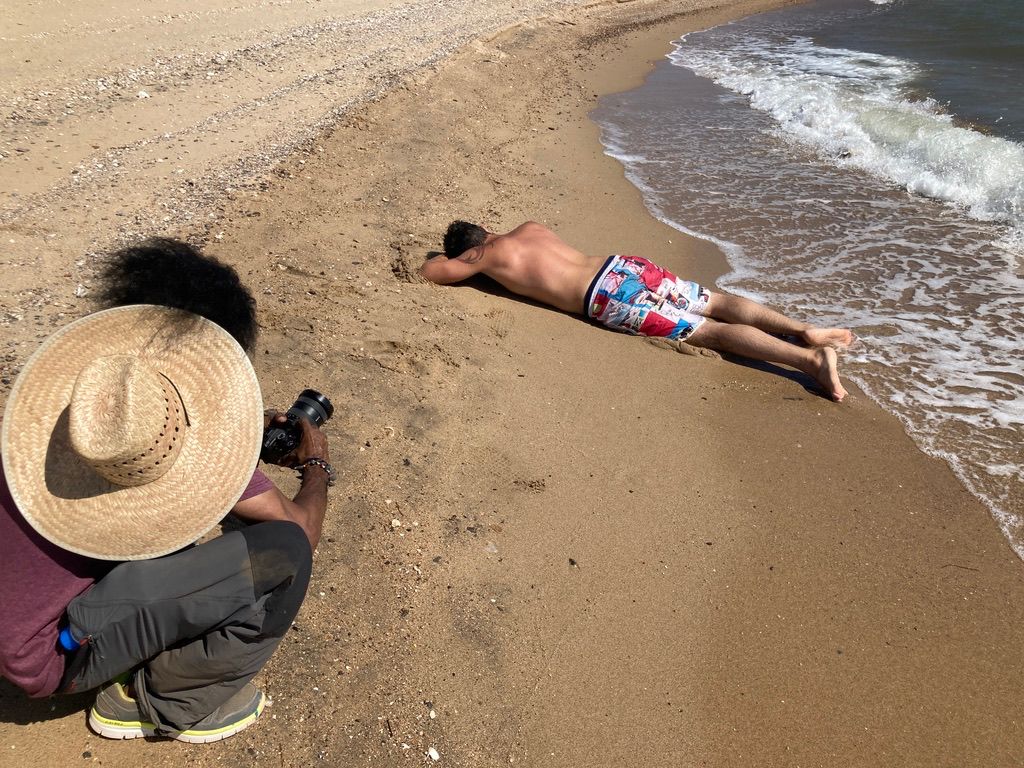
A person lies face-down in the sand after ingesting 5-MeO-DMT as part of one of Octavio’s sessions, as a volunteer assistant and patient takes a photo.
5-MeO-DMT is a fascinating substance in its own right, too. It still blows my mind that there’s a tiny molecule that can strip consciousness down to its barest essence within seconds, and then be eliminated from the psyche within half an hour. I also became very interested in the realm of pharmaceutical drug development that is also honing in on this drug in a big way because of its potency and brevity.
It just kind of sucked me in deeper and deeper. A cliché, but it’s true!
Hardman: Octavio looms large, not only in your book but also in the underground, where many people are aware of him. But I’m curious, how familiar were the people that you spoke with on the more pharmaceutical side with both Octavio as a character, but also underground practices more broadly?
De Greef: It’s notoriously difficult to get anything out of GH Research, but I know that some fairly senior people at the company were aware of Octavio because when they became interested in the molecule in around 2018 they went to a conference that he presented at.
The idea of these very straight biotechnology developers sitting and watching Octavio do one of his public performances… I would love to have been a fly on that wall!
I also know that Lady Amanda Feilding was aware of Octavio because he tried to get her to smoke toad with him at a conference, and she didn’t want to. She told me that she didn’t like his insistence, in her very British way.
I also know that the companies seeking to develop 5-MeO-DMT were intimately familiar with what was going on in the underground, to a degree that I think they couldn’t fully be transparent about because they have to come across as professional. But my understanding is that, at least from some of the companies, there were fairly intensive back channel conversations with underground practitioners, and they were all reading Erowid and trying to get a sense of what this molecule could do because the early academic research was astonishing.
I think the mission of pharmaceutical drug development and optimising dosing ranges and finding out if there are contraindications and getting robust datasets to make decisions about how and when and where to administer the drug is a completely important and legitimate mission.
But it has been interesting to observe the tensions that play out as one starts trying to do that. It sets out to solve one set of problems that the underground creates, but seems to create other problems and other conundrums.
Hardman: Part of the excitement around potential new antidepressants like 5-MeO-DMT is their apparent ability to act rapidly. Some studies, then, have focused on somewhat short-term endpoints. Through reporting Ego Trip, did you learn anything about how people fare months later?
De Greef: People are known to sometimes take quite a long time to integrate the very powerful 5-MeO-DMT experience.
There’s no shortage of testimony from very seasoned psychedelic explorers agreeing that this is unlike other trips. They say that, in many ways, it’s more extreme; it’s so fast and you kind of can lose your sense of self. So the idea that that’s not going to potentially play out over a longer timescale seems very unlikely to me.
I have been in contact with trial therapists and independent integration specialists who have worked with people who have had profound difficulties after trials have ended, and those difficulties have in some cases persisted beyond the monitoring cutoff window for safety data.
At the same time, I do understand the constraints that these companies are operating under. To get FDA approval, it’s very important to demonstrate that the drug has an effect independently, which is why therapy is minimised and standardised. I get that.
I am not convinced that that’s necessarily the most appropriate way to work with this molecule, though. It’s a strange paradox: the molecule that sort of fits best within the paradigm of mental health care is, in the underground, the one that you work your way up to, and you do when you’re really ready, and you do it with a lot of care.
I’m intensely curious how the Phase 3 trials play out.
Hardman: It strikes me as such a moving target, writing a book on a topic like this. While the throughline of the book is happening on a longer arc, developments on the drug development side are more recent and appear to be accelerating. Is there anything that has really surprised you since you submitted the manuscript, or that you would have liked to have included? Just the other week, for example, Eli Lilly announced its intent to acquire AtaiBeckley.
De Greef: It’s almost stupefying to think of this compound, which was so obscure as recently as fifteen years ago, now being subject to the largest deal in the psychedelics space and being bought by the world’s biggest pharma company. That is so rich and strange, and I think it indicates how kind of ‘up for grabs’ and unpredictable the future of psychedelics is.
It makes me think that the story I told about Octavio is almost quaint and archaic, in the sense that now this is increasingly a story of intellectual property and multi-billion dollar investments.
The pharmaceutical world is all very alien to me. One of the rewards of the book, actually, was getting to learn a tiny little bit about the pharmaceutical industry and just understanding what an incredibly complicated set of incentives they’re operating under. Contrary to what I think the companies I spoke to in reporting the book probably think about me, I do appreciate the logic that they operate under. I just don’t think that that’s always compatible with the experience that we’re talking about here.
Hardman: Conducting clinical trials of psychedelics in a way that is amenable to regulators like FDA is certainly a challenge for developers and researchers alike. Studies can also be acutely challenging for participants, too. There are at least a couple of anecdotes in your reporting, if I recall correctly?
De Greef: I’ve spoken to half a dozen or more people who have been in the room with trial subjects who have described what is a fairly common reaction in underground settings: people writhing around and screaming, shouting, crying.
In many cases, afterwards, they say that they actually had a fantastic trip. So one of the weird things with this drug is that the sort of outward manifestation and the internal manifestation can be at odds with one another.
I have been told that when people working on different trials get together at conferences, they apparently swap stories about people running around and going berserk. It’s not necessarily a bad thing, though – maybe that’s just part of the process?
I don’t find this surprising, either. It would be really weird if something that’s very common in underground and recreational settings just didn’t happen at all when you did it in the trial environment.
Hardman: There are some differences, though, perhaps with dosing, for example?
De Greef: I suspect that at least one developer has chosen a lower dose for its larger trials for that reason.
Hardman: Sticking with patient experiences, I have spoken to one 5-MeO-DMT trial participant who said that, while it may appear to be a quick experience for an onlooker, it felt like a really long time for them.
De Greef: Right, there is a mismatch between the ‘clock time’ in the room, for the monitor, and the sort of spiritual clock time of the person, going through a potentially grueling ordeal.
There’s also the matter of longer-term trajectories. One practitioner I’ve spoken to, who has been approached by people who’ve struggled in trials, says that people can feel amazing afterwards, like they have had an epiphany. Then they go back to their lives, where many of the conditions that perhaps contributed to the depression are present.
Some researchers and practitioners say that this might even make a patient feel worse, because they’ve had a glimpse of something more beautiful, only to fall back into their old reality.
Hardman: I know that the pharmaceutical side of things is just one part of your book, which focused much more broadly on the toad economy. In doing so, you raise questions around conservation and ethics. Are people more aware of these concerns today than when you began researching the book, or is the situation getting worse?
De Greef: I haven’t been to Sonora since 2023, but my sense was that it was absolutely getting worse. If people seeking the benefits of this substance had an inkling of where their ‘medicine’ was coming from, I’d wager they’d have much less nice trips.
That’s one of the core missions of the book and of my reporting, to try and connect the dots and walk back up that supply chain. What I observed was more and more people getting in on the game, trying to hustle these toads.
It has to be one of the world’s strangest little niche biotrades. These toads that are like sci-fi creatures that are invisible in the landscape for three quarters of the year, and then burst out from nowhere when it rains and start this frenzy of eating and mating, so that they can lay their eggs and have tadpoles before all the pools dry up again. And then all these people are running around with gunny sacks and buckets, catching as many toads as they can.
Because the commercial market is largely in the Mexican Sonoran Desert, where there are high levels of poverty, there’s an economy of people who are willing to do this for a few dollars a day. It’s also gangland, and so you can’t move around freely: you have to pay people who are known to the narcos in each area.
People are being paid, say, $1 for a bag of toads. In some cases, people are catching the wrong toads, or just throwing frogs in their bags.
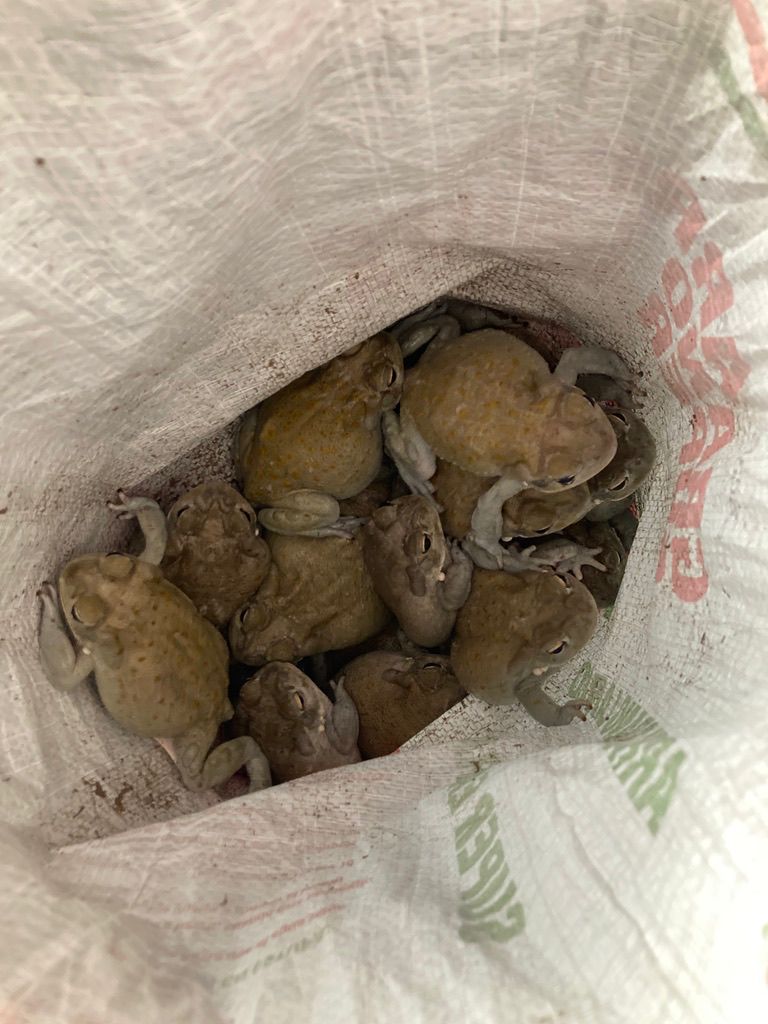
A bag of Sonoran Desert toads, Sonora, summer 2021.
Anecdotally, toads used to inundate houses, pour in through the doorways. Now, people say we don’t see the toads. No one knows if it’s specifically because of the commercial market, but there are fewer and fewer of them visible.
There’s also a kind of ranch model, where people have land and dig pits so the toads can live there. I’ve visited the land of the world’s biggest dealer of toad secretion. He was selling kilograms of the stuff a year, and he would post Facebook pictures of himself holding these sheets of dried toad secretion, the size of dinner plates; an obscene amount.
It was the most godforsaken place, and the toads kept leaving because they’re bonded to the land they come from. Thousands of toads have been trucked to his land and then tried to leave and got run over on the highways, their precious secretions driven over by trucks. It’s totally messed up.
Loads of people believe things like, ‘My shaman gets his medicine from a Mexican tribe.’ It’s mostly nonsense. I doubt there’s a single legitimate shaman collecting toad secretion, and I’ll go on record and say that. It’s toadwashing.
Hardman: Have there been any efforts to make the supply chain more ethical?
De Greef: There was an attempt to come up with a fair trade toad initiative, which was launched at the World Bufo Alvarius Congress, a short-lived gathering of the toad smoking world.
Editor’s note: It appears that there is an effort to revive the World Bufo Alvarius Congress, with a draft website citing a November 2026 meeting in Mexico City.
It fell apart the day it was announced, because the major collectors started fighting with each other on stage and accusing each other of being unethical and of abusing the toads. They put up slide shows of each other’s practices and of the toads bleeding.
There’s a toad secretion medicine that has a pinkish color, and that’s from toads that have been squeezed so many times that their glands bleed. Not good karma, I would say!
Hardman: You have been covering poaching for much of your career, including abalone poaching for example. How similar is what you saw in this area to other types of poaching?
De Greef: I would say it’s identical. It’s a black market commodity flow that’s fundamentally over-exploitative of a natural resource and conducted by people in circumstances of poverty and lack of other alternatives.
What I would say is unusual about this one is that so often poaching stories are very ‘other’. It’s often an Asian consumer and some kind of traditional use that we in the West can sneer at. While not only Westerners now smoke toad, it’s very much part of our era of wellness, self-improvement and self-optimisation.
It does make me feel quite jaded and sad about human nature. We have the only psychoactive animal in the universe that we know about with this completely singular drug compound that causes people to feel godly, but even that has just become another poaching story. I guess it’s a very human story, in that sense.
Hardman: In the book, there’s a passage where you have returned to Mexico to meet with Octavio, but he looks like he isn’t going to speak with you. Eventually, you got hold of him. Were there other people or organisations you weren’t successful in getting on the record?
De Greef: I faced by far the most headwinds with my reporting on biotech development of 5-MeO-DMT, and there is information in that domain that I would have loved to have dialed up a little bit, but I can’t go into too many specifics.
I also would have liked to have spoken to Doctor Gerry, Octavio’s friend/nemesis. I spoke to his wife, who was like his spokesperson, but he would only speak to me if he could charge me a medical consultation fee. I don’t pay for interviews!
And there are so many other fascinating figures I wish I could have spoken to. I would have loved to have spoken to Jonathan Ott. I wish I could travel back in time and speak to Ralph Metzner, and the other people who were playing around with this stuff way back when. I wish I could have met Albert Most, which Hamilton Morris did.
There are also so many people doing incredible things with this molecule, developing really careful systems of care, and doing, I believe, quite profound healing work. That’s not really the book I set out to write, but I guess I’d like the world to know that they are out there if you go looking for them. They tend not to advertise themselves as widely.
Hardman: On that note, is there anything that makes you particularly optimistic about the future of 5-MeO-DMT?
De Greef: The trial data so far are astonishing, and the idea that 5-MeO-DMT could help the millions of people whose needs aren’t being met by existing mental health treatments, is definitely a good thing – if the treatment lasts and doesn’t cause longer-term problems of its own.
My reporting also made me appreciate just how miraculous human existence is, human consciousness, evolutionary biology, the planet that we live on. You don’t need to buy into a dubious narrative about a shaman harvesting an indigenous sacrament that’s going to heal you at the hands of someone like Octavio to appreciate that we live in a very fragile and precious place.
Hardman: What are you working on next?
De Greef: I’m going totally out of the psychedelics world. I’m embarking on a book about illicit gold mining in the abandoned ruins of South Africa’s deep level mines.
It’s very different, but I have been thinking that both the toads and the gold are buried treasures that people covet and go to extreme lengths to get. So maybe there’s some continuity there.
Join thousands of psychedelics insiders
Get the weekly psychedelic medicine briefing.
A free weekly digest covering trials, regulation, policy, and access.
By signing up, you agree to our privacy policy. You can unsubscribe at any time.