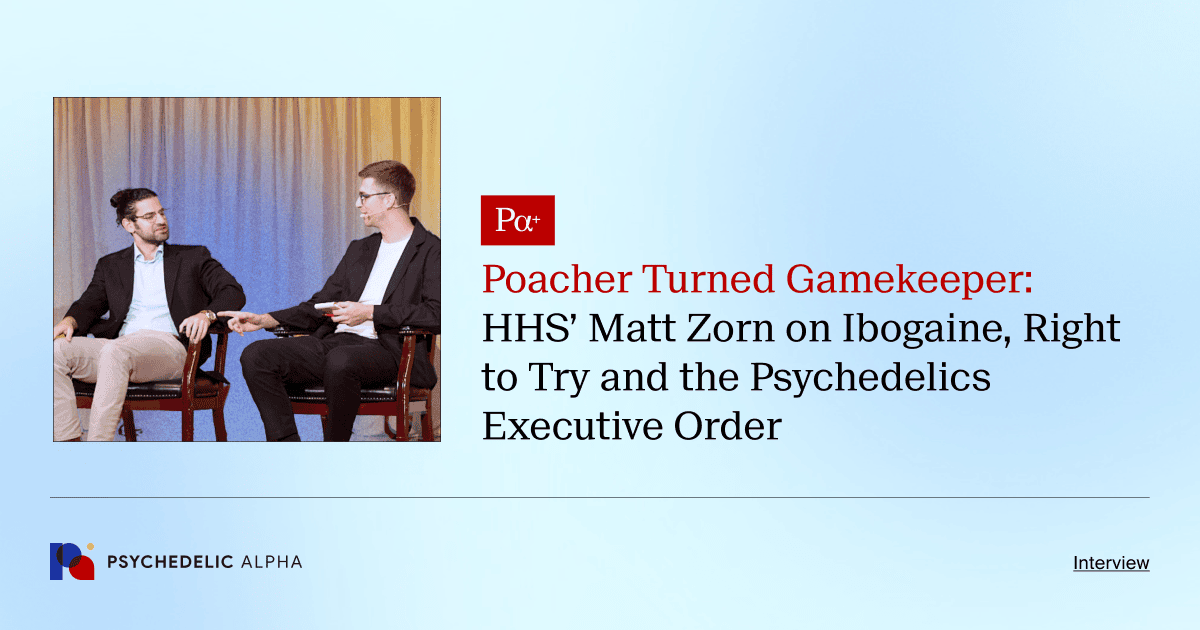
Poacher Turned Gamekeeper: HHS’ Matt Zorn on Ibogaine, Right to Try and the Psychedelics Executive Order
At The Psychedelic Healthcare Forum that we co-hosted last Thursday in New York, our Editor Josh Hardman sat down with Matt Zorn, Deputy General Counsel at the U.S. Department of Health and Human Services, for a wide-ranging discussion. It was the first in-depth one-to-one interview that Zorn has participated in since taking the role. (His last detailed interview prior to entering government appeared in these pages, too.)
Before joining the U.S. Department of Health and Human Services (HHS) in May 2025, Zorn was better known as one of the federal government’s most persistent legal adversaries on the drug policy front. As a lawyer, he sued the Drug Enforcement Administration (DEA) and HHS on matters including cannabis rescheduling and, more relevantly for our purposes, patient access to psilocybin under Right to Try. He was also involved in the challenge to the DEA’s proposed scheduling of five psychedelic tryptamines, which is now back on the docket.
Now a Deputy General Counsel at HHS, Zorn has become the department’s point person on psychedelics, earning him the informal title of ‘psychedelics czar’. He was closely involved in President Trump’s April 2026 psychedelics-focused executive order.
This interview has been edited for length and clarity.
Josh Hardman, Psychedelic Alpha: Our first session is a discussion between myself and someone that many of you will know of. Last year, when he took the role he's currently in, I called him the psychedelics czar. His official role is deputy general counsel at the Department of Health and Human Services (HHS), and he's involved in various psychedelics initiatives, including the executive order.
Matt, thanks for joining us. Before your current role, you spent a lot of time writing about and, as a lawyer, suing the Drug Enforcement Administration and HHS, mainly related to cannabis, but also psychedelics, like the tryptamines matter and Right to Try. Now you're on the other side of the fence. In the UK we have this phrase, poacher turned gamekeeper, where the person who's been causing an organisation a lot of headaches is brought into the fold. What's it like being the gamekeeper?
Matt Zorn: Well, the funny story is that was actually part of how I got the job. Part of the reason the Secretary wanted to hire me was because I was successful in bringing actions against the government.
What's been surprising? From the outside, you have this notion that the government is bureaucratic, and it is way more bureaucratic than I thought. But what was also surprising is how many people in the government, regardless of their political stripes, want to move this issue forward. I think everybody sees that there's a mental health crisis, and that there aren't great solutions.
I'm not saying psychedelics are the only solution, but I think they're a tool that can go in the toolbox, and a lot of people in government are wanting to swim in the same direction and are willing to work across political colours to do it.
We haven't really seen much in the way of true innovation in this space, and I think starting to question our status quo assumptions is essential to being able to do that. I think that is what we've seen, starting with the executive order.
Hardman: In December 2024, before you took the role, we did an interview. The headline was “Bullish on Chaos”. You said you kind of liked that RFK Jr. and the new administration were going to be a bit chaotic, and that might create an opening. Has that come true?
Zorn: It's chaotic in certain regards and less chaotic in others. But the Secretary is constantly questioning the status quo. We haven't really seen much in the way of true innovation in this space, and I think starting to question our status quo assumptions is essential to being able to do that. I think that is what we've seen, starting with the executive order. What we're doing now at HHS is not very chaotic. I think it's very orderly. But that underlying 'let's question the status quo' has helped fuel moving this forward.
Hardman: And some things are just convention, or status quo, right? They're not written in law. On your blog, On Drugs, which you wrote with Shane Pennington, you wrote about bifurcated scheduling, where an approved product containing a scheduled drug gets put in a lower schedule, but the underlying drug remains in a higher schedule, like Schedule I. You wanted to kill the canard of this being a given; you said it's more of a convention. If drugs like psilocybin are approved, is there an opportunity to push back on that?
Zorn: Well, now that I work for the government, I can't answer that question!
Hardman: It's tough being the gamekeeper! OK, I'll ask you another difficult one. Jules Evans, who writes about psychedelic safety, wrote a week or two ago about you at the MAHA Summit, where some CEOs of psychedelic drug developers had paid to participate, and you moderated a discussion and said you're very passionate about psychedelics. He asked whether that's being a bit too cosy with industry, given you're a government lawyer for the department that approves ...
Join Today
Independent data-driven reporting, analysis and commentary on the psychedelics space: from business and drug development through to policy reform and research.
- Regular Bulletins featuring news, analysis, and research
- Articles and deep dives across psychedelic drug development, policy, and research
- Exclusive interviews with researchers, executives, and policymakers
- Bespoke resources and tools including the Psychedelic Bill Tracker
- Quarterly video briefings and slide decks