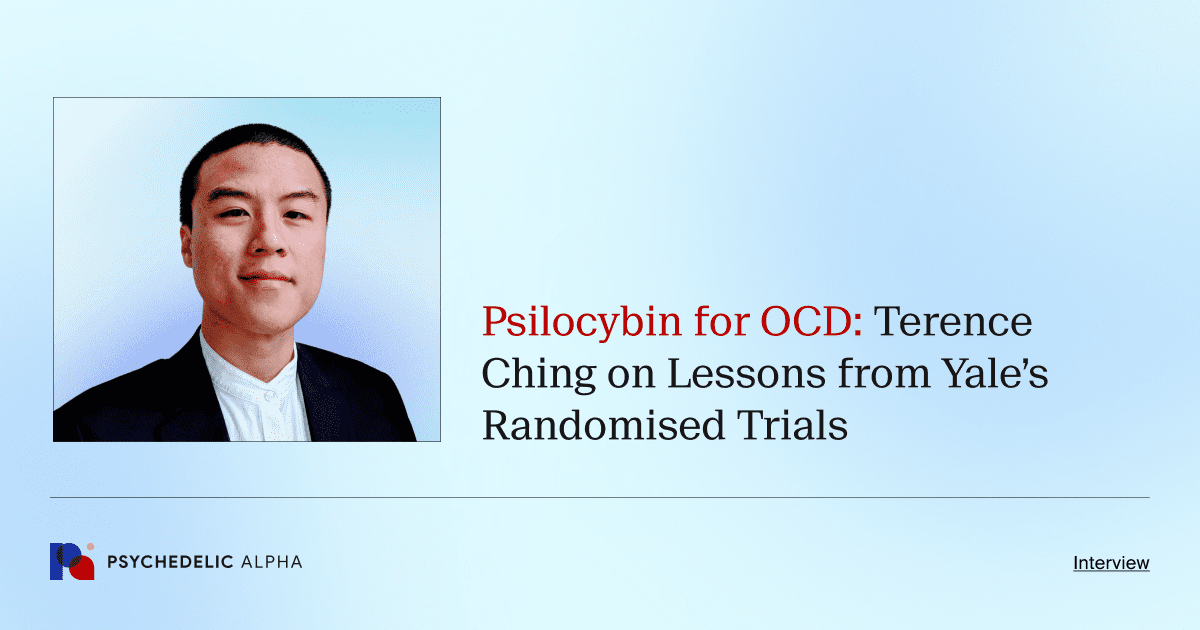
Psilocybin for OCD: Terence Ching on Lessons from Yale’s Randomised Trials
Dr. Terence Ching is a licensed clinical psychologist and researcher at Yale University, where he leads psilocybin clinical trials for obsessive compulsive disorder (OCD) within the Emerging and Novel Applications for Consciousness-Altering Therapeutics (ENACT) Research Collaborative, which he describes as the flagship lab within the Yale Program for Psychedelic Science. There, he also serves as the Director of Psychedelic Training and is responsible for training and supervising facilitators. His experience includes serving as a study therapist in pivotal clinical trials of MDMA-assisted therapy for PTSD. Dr. Ching is also the founder of Chimera Pathways, a psychotherapy telepractice that offers cognitive-behaviour therapy (CBT), acceptance and commitment therapy (ACT), and psychedelic and ketamine integration services.
In this conversation with Psychedelic Alpha’s Josh Hardman, Dr. Ching discusses his journey into the field and current work leading Yale’s psilocybin trials for OCD. He reflects on study design considerations, potential mechanisms of action, and some of the subjective phenomena observed during psilocybin sessions in those studies. Dr. Ching also explores what experience and data suggest about integrating psychedelics with evidence-based treatments like CBT and ACT.
Journey into OCD and psychedelic research
Josh Hardman, Psychedelic Alpha: Could you tell us a little bit about how you became involved in researching drugs like psilocybin and methylone?
Dr. Terence Ching: I got my start at the Yale OCD Research Clinic, working on OCD research and slowly became interested in the promise of psychedelic treatments for addressing what we had come to understand as a pretty treatment-resistant mental disorder.
A lot of this work was initiated by Dr. Francisco Moreno and his group at the University of Arizona; we just built on it. We concluded our first randomised placebo-controlled trial of psilocybin for OCD just over a year ago, and we’re working on publishing the data from that. In early February of this year, we concluded the final dosing session for our follow-up two-dose waitlist control psilocybin study for OCD, so I’m really happy about that.
That’s where I find myself occupied most of the time, working in our psychedelic research program. I’m also the Director of Psychedelic Training for the lab and the Yale Program of Psychedelic Science, so I’m really excited to be serving both in research and clinical roles, as well as an educational one. My mission, or goal, in this work is really to standardise and elucidate what it means to work with study participants through the non-directive approach, something that we’ve operationalized and implemented in the aforementioned trials.
Hardman: So is it fair to characterise you as someone who got into psychedelic research through your primary interest in OCD?
Ching: Yes, I would say my journey into the space was first and foremost academic and scientific. I got my start in psychedelic research working with Dr. Monnica Williams in the Phase 3 MDMA trials for PTSD, which were run by Lykos Therapeutics, or MAPS at the time. I was in grad school back then, new to the field of clinical psychology, and was just starting to get to know what it’s like working with clinical and psychological interventions.
And then I was thrust into this world where there were concepts I was not previously exposed to as part of my training. I remember being fascinated by the data and the large effect sizes, but also by trying to understand some of the psychological mechanisms underlying therapeutic change in that modality. This really set me on a path of diving deeper into the psychedelic research arena. That’s where I found Dr. Kelmendi, and started my postdoc with him, and now I’m part of the faculty in his lab.
Deciding on doses
Hardman: So, for the study you’re working on publishing—the single dose psilocybin for OCD one—how did you land on 0.25 mg per kilogram as the dose?
Ching: That stemmed from a multi-pronged conversation about the safety of participants. This was really a first-of-its-kind trial; this hadn’t been done before at Yale University. The work that had been done before at Yale was with ketamine; many of the researchers here are pioneers in that space.
We knew we wanted to offer a moderate dose and we were reviewing literature on the pros and cons of weight-based dosing versus a flat, fixed dose for dosing sessions. I think we decided on the more conservative option. We selected 0.25 mg per kilogram, which meant around 17-22 mg for those who were more or less average weight. It was a nice way to see if there was an efficacy signal and to see if this moderate dose was safe for participants with OCD.
OCD is an interesting mental disorder—a lot of the core characteristics speak to the need for control, the need for certainty about one’s experience, one’s state of consciousness. These may be at odds with what occurs during a psychedelic session.
Does OCD dampen psychedelic effects?
Hardman: Right, and you have previously reported that OCD interferes with the subjective experience, and maybe even dampens it in some way.
Ching: What we talked about in a recently published paper was this interesting phenomenon of partial mystical experiences for some of our participants. That’s not to say all OCD participants don’t achieve a full mystical experience, as measured by the Mystical Experience Questionnaire (MEQ), but more often than not we do see people having somewhat of a dampened psychedelic effect. This may be a consequence of the disorder coming online, or being at the forefront of their consciousness during the dosing session.
Sometimes, in psychedelic sessions, people engage in ‘looping’. We understand this as psychological resistance to the emerging acute effects of the drug, which turns into a coping response in an attempt to fight, distract, or dampen the onset of drug effects. So sometimes people might just verbally start looping, saying, ‘I want this to stop’, or, ‘Is it over yet?’
When you see this happening in a population with OCD—with whom compulsiveness about their behavioural responses to something that distresses them is at the heart of their disorder—and if we were to work with the idea that psychedelics are amplifiers, it does sometimes amplify the OCD response.
So, looping becomes an unsurprising observation, and what that does in the moment is distract their attention from other things happening in the background of a psychedelic experience. When that happens in our dosing sessions, we don’t necessarily always have an instinctive judgment about whether this is a good or bad experience—it just is happening in the moment. There’s very little one can do to try to steer them in a more relaxed direction or try to get them to resolve that looping.
What we always tell our participants is that it’s not necessarily a bad thing: even if you struggled during a challenging dosing session, that sets us up for a very interesting conversation during integration about what could be learned from this experience.
After some time has passed, when the acute effects are lessening, maybe in the third or fourth hour, people sometimes break through into a period of calm, a period of relaxation. We’ve had one person describe it as melting into the couch. It’s amazing the conclusions people arrive at in hindsight, having gone through a really challenging first half of the dosing session and then breaking through into a more peaceful and relaxing second half. Often, they see the first half as almost necessary to really appreciate just how relaxing the experience can be.
Some people draw the analogy of psychedelic experiences to life itself. Sometimes in life, you go through really hard experiences to be able to appreciate some of the more comfortable and better things in life. Sometimes we see people instil or infuse this experience with a layer of spirituality.
Two-dose study
Hardman: Is that why you’re doing the two-dose waitlist control study, because participants feel like they could have a better go at it the second time around, when they know what they’re going to be working with?
Ching: Yeah. Apart from sponsor-led trials, we’re running investigator-initiated trials, which means there’s a lot of leeway for academic creativity. Part of what we tried to infuse in the second trial was participant feedback from the first. Sometimes people receive a single dose of psilocybin and they start talking about this desire for a subsequent dose down the line. Not in the sense that they’re drug-seeking, but more that there’s this really palpable thirst for greater growth, greater recovery, greater reductions in symptoms.
So, people often muse over the prospect of doing it again, and the desire for a study with multiple doses of psilocybin. There is also a smaller subset who talk about higher doses, sometimes due to the weight-based dosing, meaning lighter people get a smaller dose.
We looked into the literature again and saw that some of our colleagues at Johns Hopkins had put out a paper talking about the merits and disadvantages of fixed dosing versus weight-based dosing. The sentiment was that they’re comparable, and it’s more pragmatic to have fixed doses. That’s what we went with in our second study.
We really want it to be data-driven again and responsive to participant feedback. When it comes to dose selection for the second dose, if people did not pass a particular threshold of symptom reduction after the first 25 mg dose, they would be bumped up to a slightly higher dose of 30 mg. If they do, they stay at 25 mg for the second dose.
Blinding integrity, expectancy
Hardman: The first study used niacin as an active placebo; how did that fare? Also, did you solicit guesses from participants, or measure expectancy?
Ching: We did informally solicit guesses from people about whether they thought they got placebo or active drug, and sometimes, participants do volunteer that information. I think we see examples on either end of the spectrum where people who got the drug were somewhat convinced they got placebo, and people who got placebo believed that they got the active drug. Some of the people who were second-guessing whether they received the drug mentioned prior experiences with psilocybin that were perhaps at a higher intensity. So, we see a smattering of participants in each quadrant here.
Proposed mechanisms of action or theories of change
Hardman: I think exposure and response prevention (ERP) is the gold standard treatment for OCD, and from what I understand, it’s to do with extinction learning. Reading your qualitative paper about the first psilocybin study you did, though, it sounds like there are other processes at play in that context. Can you share more about the kind of theory of change, or potential mechanisms here?
I guess a very broad but interesting question to tag on, here, is: Have you begun learning things through this work that make you reconsider how you think about OCD more generally?
Ching: That paper basically lays out many different routes to the same destination. And this is something I’ve really had to appreciate whilst doing this work, specifically with psilocybin and OCD; a lot of the discussed processes of change in ERP are about generating competing responses that outweigh or overwhelm initial problematic responses.
The goal of ERP is to generate healthier alternatives to those original responses, such as not washing your hands, and learning that over time, distress will fade away. This is where we get creative with other therapeutic approaches. For example, Acceptance and Commitment Therapy (ACT) is an approach focused on enabling people to appreciate that many of the things motivating us to engage in maladaptive responses aren’t necessarily real, in the sense that they are just automatic cognitions or thoughts bumping into your consciousness. And so ACT promotes a sense of defusion from the immediate experiences in your consciousness. So being able to see a thought as just a thought.
ACT talks about engaging with life in a value-oriented way, having a clear understanding of what your true core values are, and what comes into play in any particularly distressing situation. For example, ‘Should I wash my hands or actually, do I want to attend more to this conversation I’m having with my partner or friend?’
At the end of your life, you want to be able to say: ‘For all of the times I could have washed my hands, I chose to engage with life in a more meaningful way’. This represents many of the different processes of change we see happening in people after a psychedelic session in our OCD trials.
Integrating psilocybin with evidence-based therapy
Hardman: So the post-psilocybin changes observed in participants in your OCD trials are in line with the types of things you see in ACT?
Ching: They can be. Psychedelics are amplifiers for lots of different things. A lot of our participants are treatment-resistant; many of them have engaged with evidence-based psychotherapy. So a lot of these initial learnings have just been sitting in the back of their mind. Then, after a psychedelic experience, what’s residing there in the back of their mind becomes amplified and more pronounced. It feels really profound to have that understanding that’s been seeded before you even had your psychedelic session.
So we see a lot of that happening where people say ‘Oh, I knew it was possible to react to my obsessions in this healthier way, but now I truly feel and know that this is a viable option, and now I am going to do more of that moving forward with my life. I’m not going to clean as much as I did, or check or engage in other compulsions as much as I did, and that is in service of what I truly value in life’. So we see a lot of these processes of change coming to life.
Some people even talk about wanting to get back into therapy because they’re eager to keep up the momentum. They have this deep level of knowing regarding what they were taught before in therapy, and now they really want to put it into action, give it a good go this time round.
But there are lots of different conversations going on during and after dosing sessions, some of which veer into the spiritual, with many having this deep understanding that they’re loved by God, loved by friends and family members. Often, the person may have been obsessing about whether people like them, or think they’re unkind; all of those layers of obsessive doubt dissolve because there’s this deeper knowing of being loved by the people in their lives.
And so here we are, at the end of two completed trials of psilocybin for OCD, feeling really heartened and confident about the integrative potential of psychedelics with evidence-based therapy. We’re eagerly developing protocols that seek to bridge the gap between what we know in clinical psychology and what we know in psychedelic science, to see if this can lead to an exponential gain for our participants.
‘Types’ of OCD
Hardman: I know it’s been a relatively small number of participants thus far, but I’m wondering if you have any intuition about types of OCD patients, or types of symptoms, that respond best to psilocybin?
Ching: We have a natural human tendency to categorise things, and it’s great to appreciate the heterogeneity of OCD, but at the heart of the disorder is a common recipe that something, for some reason or another, is attacked and latched onto. It can be something rooted in reality, such as germs, or something not particularly rooted in reality, such as zombies or aliens or monsters.
Through our work with our participants, we see how, with the help of psilocybin, people are able to see through the illusion of OCD and really get to the heart of what troubles them. Where the fear really stems from is that there are things in life you can’t quite get a handle on. There is a true mystery to life sometimes, and it’s because you care so much about wanting to be liked, or wanting to do good in this world, wanting to give love to people, wanting to be loved by others, that the OCD has almost hijacked this as fuel for all of the obsessions and compulsive urges.
Sometimes, in these dosing sessions, we begin to see OCD as a separate entity from the individual, even though it’s a definable neurological disorder. There is a separateness people feel from their mental disorder that feels really amazing. We see a version of that in psilocybin for folks with cancer anxiety—they see their cancer as separate from themselves.
Speaking to the idea of neuroplasticity and the notion of a critical window that we can tap into, people begin to question whether their compulsions are necessary. So the question becomes: What else can we do to empower people, to help them break away from feeling constrained by the disorder?
Non-directive approach
Hardman: And what does this all look like in terms of integration or post-dosing support?
Ching: The non-directive approach is really at the heart of all of our interactions with study participants. The non-directive approach is synonymous with participant-led and participant-centred stances.
I typically offer this metaphor to participants at the start of our work: The participant is someone who is jogging down a path, and we, as facilitators, are simply jogging alongside them. We won’t be trying to steer them in a particular direction. We won’t grab their arm and slow them down. If they speed up, we’re doing our best to catch up, right by their side. We won’t get ahead of them: if they slow down, we’re slowing down as well. If they choose to jog backwards, we’re doing the same. We’re right by their side until they can resume going down that path again, wherever that may lead.
So, in a very real way, that’s how we show up for people. If we’re talking to people at all, we’re asking questions, which we’re very intentional about. We’re asking very simple, very open-ended questions which essentially they can choose to respond to or not. It’s all about what and how they want to feel, think, or be, in the moment.
Lower doses, single doses, trial-related symptoms
Hardman: That makes sense. There was a study here in the UK that published last year. They used a fixed 10 mg dose for OCD. Do you have any thoughts about that?
Ching: The biggest thing that stood out to me from the data was the very robust safety profile of a small dose of psilocybin for OCD. I think they were trying to see if this was actually feasible and tolerable for people with OCD, and they have a clear answer to that now, which is yes.
I think we’re now moving towards asking what the sweet spot is for people with OCD: does everyone need to go through repeated dosing, or can they benefit from a single dose?
I say that because in our two-dose study, there are a few people who have dropped out consistently after the first dosing session, not due to an adverse event, but merely because they feel like they’ve covered a lot of ground and they’re uncertain about if or when they’ll next want another dosing session—it might be months, years, or maybe never.
Hardman: Presumably, in your protocol, you have a set time when they’re expected to take the second dose—are you saying that people don’t want to be on a fixed timeline?
Ching: It’s more that they might feel they’ve gotten enough from the first dose, and so they’re unsure whether they will want another one at all.
One consistent observation was that participants’ OCD decided to latch onto the study itself, which speaks to the feasibility of running a psychedelic trial with OCD; you run the risk of people obsessing and having intense doubts about the risks of psilocybin dosing, which flies in the face of actually completing a single dosing session and coming out of it unscathed. You can really see the OCD getting into the driver’s seat here and making the decisions, so that was really interesting to observe as well.
Hardman: Is that just something you observe qualitatively, or are you administering questionnaires about expectancy and how participants feel going into it?
Ching: At the start of every dosing session, we administer the Stanford Expectations of Treatment Scale (SETS), and we also ask them about how they’re feeling going into the study itself. Every time people choose to drop out, we try our best to get a sense of their motivations for not continuing.
Publication timeline
Hardman: When will the full data be available from that first study, and what’s the timeline for the second study?
Ching: For the first study, the manuscript is actively under review, so we should anticipate full publication in the coming months. For the second study, we still need to see our last participant through to the primary endpoint and begin cleaning and analysing data for publication of primary outcomes. Hopefully this will be in the summer or sometime later this year. All of these people are also followed up for 12 months, so that data will also be published in the coming years.
Commercial interest and unmet need
Hardman: You mentioned some of the benefits of academic trials, like flexibility in study design, but in order to really reach patients at scale, we conventionally rely on sponsored trials. Have you been approached by any commercial entities interested in sponsoring larger studies?
Ching: Not myself, although I would be open to conversations!
OCD can be a poorly understood disorder. It actually ranks up there with depression, anxiety, and even schizophrenia. In terms of impairment and disability, it is one of the top mental disorders—it has a very long latency from initial symptom onset, or discovery, to treatment. The supposed norm is seven years from when you’re aware that you have symptoms to when you first talk to a mental health professional about it. Some people never even get there.
OCD is an incredibly disabling disorder, so this is a critical topic to be discussing, especially in the psychedelic space.
Join thousands of psychedelics insiders
Get the weekly psychedelic medicine briefing.
A free weekly digest covering trials, regulation, policy, and access.
By signing up, you agree to our privacy policy. You can unsubscribe at any time.