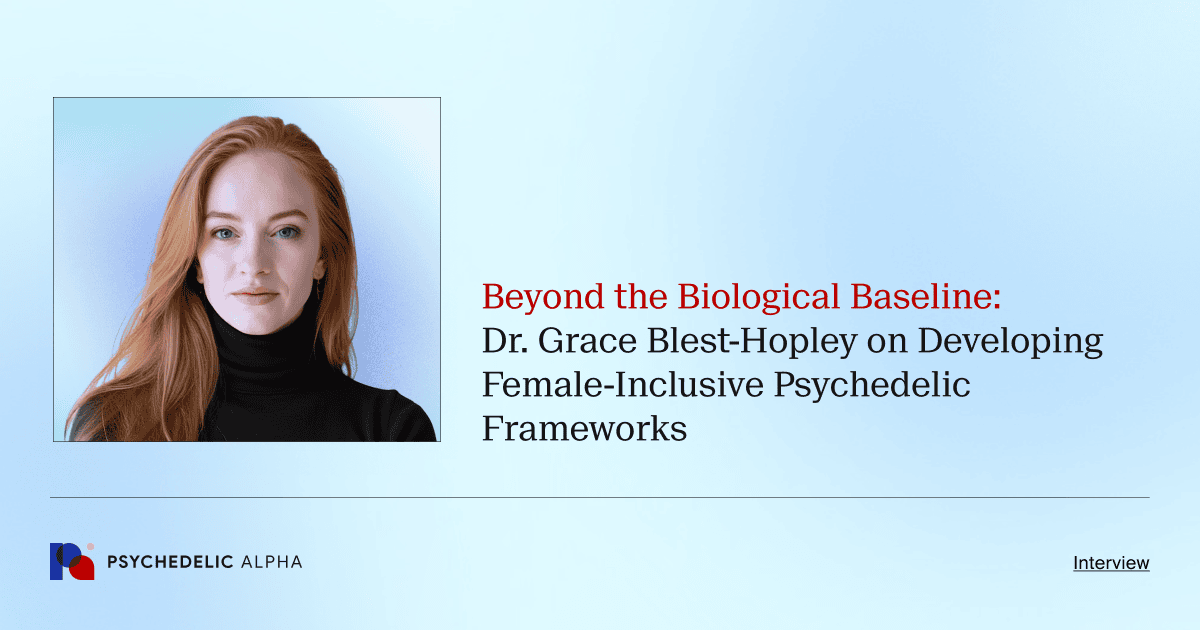
Beyond the Biological Baseline: Dr. Grace Blest-Hopley on Developing Female-Inclusive Psychedelic Frameworks
- From Fringes to the Forefront
- Medical Gaslighting and Widespread Misunderstanding
- The Hormonal Crossover
- Emerging Data: Female-Specific Symptom Improvements
- Psychedelics and Body Image
- Psychedelics for Autoimmune Disorders and Chronic Pain
- Designing Female-Sensitive Clinical Trials
- Filling In The Gaps: Women’s Psychedelic Experiences
- Integrating Indigenous Expertise
- Harm Reduction As The Starting Point For Progress
Dr. Grace Blest‑Hopley is a researcher specialising in the neurochemical and neurofunctional underpinnings of cannabis, cannabinoids, and psychedelics. She is Chief Scientific Officer at NW PharmaTech and the founder of Hystelica, an organisation dedicated to advancing women’s health research within psychedelic science—working to develop female-sensitive clinical frameworks that integrate hormonal profiling, menstrual‑cycle tracking, and trauma‑informed approaches.
Psychedelic Alpha’s Alice Lineham sat down with Dr. Blest‑Hopley at ICPR in Haarlem to discuss how hormonal cycles, reproductive transitions, and trauma shape women’s responses to psychedelics, the need for female‑sensitive clinical trial design, and the value of Indigenous knowledge in re‑imagining women’s health research.
‘When conferences acknowledge the importance of women’s health, that recognition travels up the chain to funders, and they begin to take it seriously. I truly believe we’re on the cusp of seeing dedicated funding come through—support that will allow us to do the foundational work essential not only for harm reduction but for developing effective treatments for women.’
From Fringes to the Forefront
Alice Lineham, Psychedelic Alpha: You opened ICPR with the first keynote on the mainstage, which feels like a milestone for women in the field. How did that opportunity come about?
Dr. Grace Blest-Hopley: Absolutely. I think we’ve seen a huge step change in the psychedelic field and how it views the importance of women’s health. When I first founded Hystelica nearly four years ago, I was getting pushback that this was a niche topic. At psychedelic conferences, there were very few, if any, conversations about women’s needs or women’s health.
Hystelica has really been at the forefront of changing that. It all began when we wrote an open letter to MAPS after the 2023 conference, pointing out that not a single talk focused on women’s biology. We highlighted what a major oversight that was, given that the biological, psychological, and sociological implications of being a woman; mean there are many mechanisms that intersect with both the pharmacological and therapeutic aspects of psychedelics.
Slowly we’ve seen change, and we’ve seen women’s health being billed a lot higher at many of the recent conferences. We were very excited to be given a whole panel at the MAPS conference last year, and again at Breaking Convention just a week ago. But ICPR feels like another step up from that. It was acknowledged in the opening ceremony that the majority of the ICPR board are women, and I think having women in those decision‑making positions is what’s driving genuine progress. You could feel that recognition throughout the event, and I’m hugely grateful we were given the first keynote on the main stage. It really set the tone for the conference.
We’re now here on day two, and I’ve been approached almost every hour by someone who attended my talk—people wanting to say thank you for the work we’re doing and how pleased they are to see this conversation moving forward. Tomorrow, I’ll join a panel with four of the leading women in Europe currently running psychedelic trials and therapies.
Having that recognition on the main stage has also meant that a number of funding bodies have reached out to have conversations. When conferences acknowledge the importance of women’s health, that recognition travels up the chain to funders, and they begin to take it seriously. I truly believe we’re on the cusp of seeing dedicated funding come through—support that will allow us to do the foundational work essential not only for harm reduction but for developing effective treatments for women.
Medical Gaslighting and Widespread Misunderstanding
Lineham: You began your talk by noting that Western medicine has historically treated women as “little men,” assuming our biology to be largely interchangeable. Setting psychedelics aside for a moment, what has that meant for medicine more broadly—the treatments women receive, and the outcomes they experience?
Blest-Hopley: Well, medical gaslighting for women is a real thing. Every time I mention it, I see so many women recognise it as part of their own lived experience. When you’re medically gaslit—told that what you’re feeling isn’t real or that your symptoms are exaggerated—that disbelief becomes internalised. Women lose trust in themselves and in their own reality, especially when the people who are trained in these issues, like our frontline physicians, are denying our reality.
The root of this problem lies in how little understanding there is of female biology. Fundamental processes, like how oestrogen and progesterone shape brain function, perception, and emotional processing, are absent even from advanced psychiatric training, let alone medical school or basic biology education. We all learn about boys’ wet dreams at fourteen, yet no one teaches girls that hormonal changes can profoundly affect mood, executive functioning and emotional processing throughout the menstrual cycle.
‘Fundamental processes—like how oestrogen and progesterone shape brain function, perception, and emotional processing—are absent even from advanced psychiatric training, let alone medical school or basic biology education. So this has led to widespread misunderstanding in medicine about [women’s] bodies.’
So this has led to widespread misunderstanding in medicine about our bodies. We see this play out in the time it takes for women to get diagnosed with certain conditions; it’s over eight years women usually wait to get a diagnosis for endometriosis. Yet we know this is a serious chronic pain disorder that can really affect people’s lives, ability to work, to have children, yet it is just not taken seriously.
We assume we can merely extrapolate (or not even that) from men’s data to women, disregarding the entire system that is women’s endocrinology and reproductive potential as not relevant to our health and wellbeing.
The Hormonal Crossover
Lineham: Why are these shortcomings so important in the context of psychedelics, specifically?
Blest-Hopley: Well, we know from a very basic mechanistic level that if we take estrogen and look at the mechanisms, there is significant crossover with a number of mechanisms involved in psychedelic action. We know estrogen affects the serotonergic system tone via a number of different mechanisms, both through the amount of serotonin that is produced, the way it’s metabolised, and even the density of the 5-HT2A receptor itself. This could significantly alter pharmacokinetics or pharmacodynamics.
‘From a very basic mechanistic level that if we take estrogen and look at the mechanisms, there is significant crossover with a number of mechanisms involved in psychedelic action. We know estrogen affects the serotonergic system tone via a number of different mechanisms, both through the amount of serotonin that is produced, the way it’s metabolised, and even the density of the 5-HT2A receptor itself.’
If we look at other hormones like progesterone, which exerts much of its influence through the GABAergic system, we see that when levels drop, anxiety and intrusive thought patterns often rise. For women who are highly sensitive to hormonal changes, this may result in the development of disorders like PMDD, which is associated with high suicidal ideation and suicide attempts.
Viewed through the lens of set and setting, if we fail to account for these profound hormonal shifts when preparing participants for ceremony, we risk dosing women at times when their neurobiology makes it unsafe. Psychedelics are just internal amplifiers, so if we’re not looking at how the effects of hormones are affecting our internal landscape, and then we’re applying an amplifier, like a psychedelic, we could be amplifying these negative states rather than positive ones.
‘If we fail to account for these profound hormonal shifts when preparing participants for ceremony, we risk dosing women at times when their neurobiology makes it unsafe. Psychedelics are just internal amplifiers, so if we’re not looking at how the effects of hormones are affecting our internal landscape, and then we’re applying an amplifier, like a psychedelic, we could be amplifying these negative states rather than positive ones.’
We also need to think about things like our hypothalamic-pituitary-adrenal (HPA) axis and its role in the stress response. We know that women are particularly prone to dysregulation within the HPA axis, which can affect things like our reproductive function, fertility, and our cortisol reactivity to stress during different times of our cycle. So this is all going to affect a) how much our body has a stress response to a psychedelic when we take it, but also b) how our body might then re-regulate its HPA axis, and potentially re-regulate our reproductive system.
It’s also crucial we go beyond biology and consider differences in psychological and social dimensions, in terms of emotional processing and how that can play out in psychedelic experiences. Some of the most interesting work, I think, is around lived experience and the sociological realities of being a woman: how we’re viewed by society, how safe we feel in certain environments, and how prior experiences—being dismissed or gaslit by medical systems, or navigating reproductive events such as birth, miscarriage, or abortion—can all surface within psychedelic experiences.
‘Some of the most interesting work, I think, is around lived experience and the sociological realities of being a woman: how we’re viewed by society, how safe we feel in certain environments, and how prior experiences—being dismissed or gaslit by medical systems, or navigating reproductive events such as birth, miscarriage, or abortion—can all surface within psychedelic experiences.’
Acknowledging these realities is fundamental to creating genuinely safe containers, with facilitators who are equipped to hold space for women processing such experiences. It’s vital that we create spaces that do feel safe and supportive for women, that aren’t going to re-traumatise, dismiss their reality, or even shame them, especially when reproductive traumas arise during ceremony and are not properly held by facilitators.
Emerging Data: Female-Specific Symptom Improvements
Lineham: What studies have you carried out at Hystelica so far, and what early findings are beginning to emerge?
Blest-Hopley: We’re acutely aware of the enormous gap in the literature when it comes to understanding psychedelics in women’s bodies. But it’s equally important to recognise the wealth of wisdom that already exists within the community. That’s where we began: by trying to capture some of that lived knowledge. We launched the first female‑focused psychedelic survey, asking women who had taken large doses of psychedelics, often in ceremonial settings, whether they noticed changes in their menstrual cycle or menopause symptoms.
We’ve now completed analysis of the first data set and found some significant changes. Women reported improvements in the psychological aspects of menstrual‑cycle symptoms—things like anxiety and mood changes—but also behavioural shifts, including enhanced cognitive and occupational functioning. Many even described reductions in menstrual pain, with cramps easing after psychedelic experiences. Among women with premenstrual dysphoric disorder (PMDD), these effects were seen in an even greater proportion.
‘Women reported improvements in the psychological aspects of menstrual‑cycle symptoms—things like anxiety and mood changes—but also behavioural shifts, including enhanced cognitive and occupational functioning. Many even described reductions in menstrual pain, with cramps easing after psychedelic experiences.’
We see this across the board with a lot of psychedelics: when we’re already at a baseline considered normal, we often don’t see a significant change; but when we look at those with PMDD, who suffer greatly from premenstrual symptoms, we see much greater shifts. So, it could very well be that psychedelics may not alter menstrual‑cycle symptoms for everyone, but where those symptoms are problematic, women are reporting meaningful improvements.
This is all quantitative data, but we’re very lucky at Hystelica to have become a trusted organisation where women feel comfortable sharing their stories, which is where we see stuff that is really impactful. We’ve heard from women whose menstrual cycles had stopped due to high stress or eating disorders, who found their cycles returning after high‑dose psychedelic experiences. A number of women who come to us with PCOS (now renamed Polycystic Metabolic Ovarian Syndrome) have described improvement in the regularity of their menstrual cycle following large doses of psychedelics. These are all markers of fertility, so it could be that where women are having issues with stress or HPG-axis dysregulation that may be contributing to reproductive challenges, psychedelics could play a role in helping the body re‑regulate.
We’ve also looked into menopause and perimenopause—areas of enormous burden for women that are not well recognised, and certainly not well researched or treated. We’ve encountered a number of women going through these transitions who have used psychedelics and found incredible benefit, some of which has been in their symptomology—things like anxiety, sleep issues, and brain fog—but also in remarkable stories of transformation and acceptance.
‘We’ve heard from women whose menstrual cycles had stopped due to high stress or eating disorders, who found their cycles returning after high‑dose psychedelic experiences. A number of women who come to us with PCOS—now renamed PMOS—have described improvement in the regularity of their menstrual cycle following large doses of psychedelics. These are all markers of fertility, so it could be that where women are having issues with stress or HPG-axis dysregulation that may be contributing to reproductive challenges, psychedelics could play a role in helping the body re‑regulate.’
Moving through this milestone in a woman’s life, from premenopausal to postmenopausal, marks the end of our reproductive years and changes how we’re viewed in society. Women are finding a deep sense of peace and acceptance through the use of large doses of psychedelics, helping them move through this phase with far less distress and grief than is often associated with it.
Psychedelics and Body Image
Lineham: I’ve spoken with several women coming out of psychedelic retreats, and what’s fascinating is that, regardless of age, whether they’re 32 or 72, the majority of them describe a shift in how they perceive their bodies. How do you think psychedelics might be influencing this relationship with body image more broadly, and is there any research exploring this?
Blest-Hopley: Body image is one of the main factors driving eating disorders, which are far more prevalent in women and among the most fatal psychiatric conditions. We know that psychedelics can help us accept, on a fundamental level, that we are imperfect human beings—despite the fact that society often projects an unattainable image of perfection. Psychedelics allow us to see beauty in imperfection, which is incredibly important when we think about body image. I also think we begin to gain a deeper appreciation for our physical bodies when we use psychedelics.
‘Psychedelics allow us to see beauty in imperfection, which is incredibly important when we think about body image. I also think we begin to gain a deeper appreciation for our physical bodies when we use psychedelics.’
Also, we often see somatic experiences during psychedelic sessions, things like shaking. Many women experience a disconnection from their bodies, often because of experiences such as medical gaslighting, where we’re told that what we feel physically isn’t real. Over time, that can lead to a profound disconnection from ourselves.
I come at this more from a neuroscience perspective, so to speak more about where we can go from here and the current research. In terms of research, there’s growing work on eating disorders and psychedelics, and a lot of movement in the past few years. Several small pilot studies have shown promising results, and we’re now seeing larger phase‑two RCTs being planned with both psilocybin and MDMA for this population.
I really believe that these treatments could be extremely powerful, but we need to think about safety within this population. First and foremost, when we think about set and setting, and about using psychedelics with anyone, we need full buy‑in: 100 percent consent. One of the challenges with eating disorders is that they’re often ego‑syntonic: patients may not want treatment or believe anything is wrong. So we need to consider how to engage these women, how to prepare them properly for ceremony, and what physiological challenges arise when treating someone with very low body weight.
In women with eating disorders, one of the first changes we see is disruption to the menstrual cycle and hormonal balance. Oestrogen levels drop—and beyond its neuroprotective role in the brain, oestrogen has important cardiovascular effects too. Women who have been underweight and amenorrheic for long periods carry higher cardiovascular risk, and since psychedelics themselves place a load on the cardiovascular system, we need to be especially cautious in this group.
I think the way we can look to move forward is by recognising that, while it’s great we have these trials and can start bringing these treatments into practice, there are still limitations. At the moment, to begin clinical trials using psychedelics, participants are generally required to be treatment‑resistant or to have failed several other interventions before they can be enrolled. For women with body‑image issues and eating disorders, reaching that point often means they’re already quite far along in the illness. That makes the things I mentioned earlier, like ensuring full consent and safety under the medicine, much more difficult.
‘One of the challenges with eating disorders is that they’re often ego‑syntonic: patients may not want treatment or believe anything is wrong. So we need to consider how to engage these women, how to prepare them properly for ceremony, and what physiological challenges arise when treating someone with very low body weight.’
So we need to think not only about whether we can use psychedelics for eating disorders, but when we should introduce them. What are the earliest signs that someone might be heading toward an eating disorder? Could psychedelics be used earlier to help improve body image and prevent the development of a full‑blown disorder, which is so difficult to treat and has such a destructive feedback loop? Once someone is deeply in an eating disorder, the effects of the disorder itself tend to perpetuate it, making recovery even harder.
Psychedelics for Autoimmune Disorders and Chronic Pain
Lineham: And in terms of other conditions that disproportionately affect women, things like autoimmune disorders and chronic pain, I don’t believe there’s a specific research focus there yet. But you wrote an interesting article recently that started to theorise why this might be a fruitful area to explore. Perhaps you could summarise the key points from that piece?
Blest-Hopley: Absolutely. It’s fascinating to consider that around 80 percent of autoimmune disorders occur in women rather than men. We know there are certain genetic variants that create differences in immune function between the sexes, and that accounts for part of the picture. But one of the most interesting correlations in autoimmune disorders is with adverse life events and high‑stress environments. People often develop autoimmune conditions during periods of intense stress, and one thing we do know about psychedelics is that they can help us process trauma and address adverse childhood experiences very effectively.
So I think we need to start viewing autoimmune diseases not only as disorders of the immune system, but as disorders of the body’s broader regulatory systems. That means exploring interventions that don’t just target the immune system directly, but also help to re‑regulate the nervous system, which may in turn have therapeutic effects.
In that article, I mentioned several case studies. You’re right that we don’t yet have robust clinical data, but among women who’ve used psychedelics in retreat settings—particularly those with autoimmune conditions linked to the thyroid, such as Hashimoto’s—we’ve seen reported improvements in biomarkers following high‑dose experiences. It’s an area that absolutely warrants structured study and, ideally, clinical trials.
‘Among women who’ve used psychedelics in retreat settings—particularly those with autoimmune conditions linked to the thyroid, such as Hashimoto’s—we’ve seen reported improvements in biomarkers following high‑dose experiences. It’s an area that absolutely warrants structured study and, ideally, clinical trials.’
On the chronic‑pain side, we’re already seeing promising data. I’ve collected findings in military veterans showing encouraging improvements in pain outcomes. What’s interesting is that much of this change isn’t just about the pain originating in tissue, it’s about the perception of pain and our relationship to it.
Women, in particular, often experience chronic pain conditions such as endometriosis or vulvodynia, and because of years of medical gaslighting, their nervous systems become primed to expect pain. When psychedelics are used intentionally, alongside education, embodiment, and somatic practices, the combination of insight and neuroplasticity may help to rewire the body’s connection to areas of pain, and possibly reshape the blueprint of how we anticipate it, which could have a profound impact on how chronic pain is experienced day to day.
Designing Female-Sensitive Clinical Trials
Lineham: And when it comes to running these trials with women, what methodological shifts do we need to make, and what measures do we need to start including?
Blest-Hopley: First and foremost, we need to be collecting information about the menstrual cycle. One thing we know is that when oestrogen levels change, it alters pain receptors and pain perception, so women’s experience of pain shifts across the menstrual cycle. So if we’re going to test anything related to pain—as is the case with anxiety, or depression—we need to consider how symptoms fluctuate throughout the cycle. I believe this should be a standard measure for all women in clinical trials, but it’s particularly relevant here.
When we think about autoimmune disorders and chronic pain, it’s also important to interrogate factors like adverse life events. We should start identifying subgroups within these cohorts—those whose conditions are associated with trauma or high‑stress experiences—because psychedelics may be especially useful for that population. By contrast, someone whose autoimmune disorder is primarily driven by genetic factors may not respond in the same way.
Ultimately, we need to understand the root cause of each disorder and begin, as we always should, from the patient—focusing on what we are treating, not simply what we are treating with. That approach will be vital for designing patient‑informed and female‑sensitive clinical trials.
Filling In The Gaps: Women’s Psychedelic Experiences
Lineham: What would you say are the main focus areas you’re thinking about at Hystelica—where do you see the research heading and what are the big gaps or missing pieces you’re most keen to focus on next?
Blest-Hopley: We’ve done a good job of establishing signposts through the surveys we’ve run, the case studies we’ve collected, and the literature reviews we’ve conducted. But one of the biggest challenges holding us back is that we simply don’t have enough data, and we can’t expect people to collect data if they don’t have the right tools to do it. So the next major project, and the biggest gap we see in the field, is to provide those tools.
‘One of the biggest challenges holding us back is that we simply don’t have enough data, and we can’t expect people to collect data if they don’t have the right tools to do it. So the next major project, and the biggest gap we see in the field, is to provide those tools.’
Of course, if you’re going to create something intended for widespread use across an industry, it needs to be designed collaboratively, with input from more than one perspective. That’s why we’re launching a Delphi study at Hystelica, bringing together a consensus of over fifty experts, from gynaecologists to Indigenous leaders, to identify the key domains in women’s psychedelic use that are essential for data collection.
The goal is to build a framework that allows us to fully understand women’s psychedelic experiences, from hormonal profiles and how hormones affect symptomology, mindset, and body‑set, through to lived experiences, reproductive health, and trauma histories. Experiences such as birth, miscarriage, or other reproductive events are vital to consider when we think about how a woman experiences a psychedelic, whether she finds it profound or not may well relate to whether she’s ever given birth, for instance.
These lived experiences are not captured in any of the current questionnaires developed for the psychedelic field, and that leaves a huge gap in our understanding of how women experience psychedelics compared to men.
‘The goal is to build a framework that allows us to fully understand women’s psychedelic experiences, from hormonal profiles and how hormones affect symptomology, mindset, and body‑set, through to lived experiences, reproductive health, and trauma histories. Experiences such as birth, miscarriage, or other reproductive events are vital to consider when we think about how a woman experiences a psychedelic.’
Integrating Indigenous Expertise
Lineham: And just to follow on from that, you mentioned the Delphi study and bringing together a consensus of experts, including Indigenous groups and communities. How and why do you think we need to be communicating with healers who’ve been working with these medicines for generations, what can we learn from them, and how can we do that meaningfully?
Blest-Hopley: I think there’s an enormous amount of wisdom to be learned from Indigenous communities, and that wisdom needs to be understood from their perspective, but also reflected into our Western models. These communities are valuable to our understanding precisely because they sit outside many of the belief systems that have shaped Western views of women—the legacy of ‘hysteria,’ for instance, or the long framing of women’s bodies as something to be managed. Many traditions hold understandings of the body, sexuality, and the life stages that differ markedly from ours, often with far less shame attached.
That creates a fascinating space for exploration. Hearing how different communities understand perimenopause, birth, and the menstrual cycle, outside the Western lens, can offer a lot of insight.
Beyond that, many women in these communities have worked with plant medicines, psychedelic and non‑psychedelic alike, for generations to treat a range of health conditions. Through thousands of years and countless iterations of these practices, they’ve developed their own protocols and understandings of women’s health which is knowledge that’s largely absent in the West due to a lack of recognition, funding, and inquiry into female‑specific conditions.
In Western medicine, menstrual‑cycle disorders and menopause symptoms are often dismissed as non‑essential to treat. Yet when you speak with Indigenous healers, they’ll say, “Of course, we use this plant for that symptom.” Meanwhile, a Western doctor might have nothing to offer. There’s so much potential to learn from these traditions and to investigate their medicines in structured, clinical settings, because we are severely lacking effective treatments for many of these conditions.
‘In Western medicine, menstrual‑cycle disorders and menopause symptoms are often dismissed as non‑essential to treat. Yet when you speak with Indigenous healers, they’ll say, “Of course, we use this plant for that symptom.” Meanwhile, a Western doctor might have nothing to offer.’
Harm Reduction As The Starting Point For Progress
Lineham: Is there anything else that we haven’t touched on that you would like to mention?
Blest-Hopley: I think the reason Hystelica exists is twofold—it’s for the good, but also to prevent harm. First and foremost, we have to think about this through a harm‑reduction lens. As psychedelic medicines move toward clinical use and out of the communities that have long worked with them, where people often come with deep belief and understanding of the medicine, we’ll be engaging with a very different population. Harm reduction must be at the forefront if we want the industry to thrive and avoid serious adverse outcomes.
We already know that women experience adverse effects from licensed medicines far more frequently than men, largely because those medicines were not properly investigated at the clinical‑trial stage. So we must collect the right information now to prevent similar issues, potentially including increased suicidality among women with PMDD, which would be catastrophic for the field and could undermine years of investment and progress.
On the positive side, we’re finally recognising that women’s health matters. The unmet need is vast, and so is the potential: we have almost no effective treatments for many menstrual‑cycle and menopause‑related disorders. If psychedelic medicine can begin to fill that gap, the benefit to women’s lives would be significant in its own right.
‘We already know that women experience adverse effects from licensed medicines far more frequently than men, largely because those medicines were not properly investigated at the clinical‑trial stage. So we must collect the right information now to prevent similar issues—because harm reduction has to come first if we want this field to last.’
Join thousands of psychedelics insiders
Get the weekly psychedelic medicine briefing.
A free weekly digest covering trials, regulation, policy, and access.
By signing up, you agree to our privacy policy. You can unsubscribe at any time.