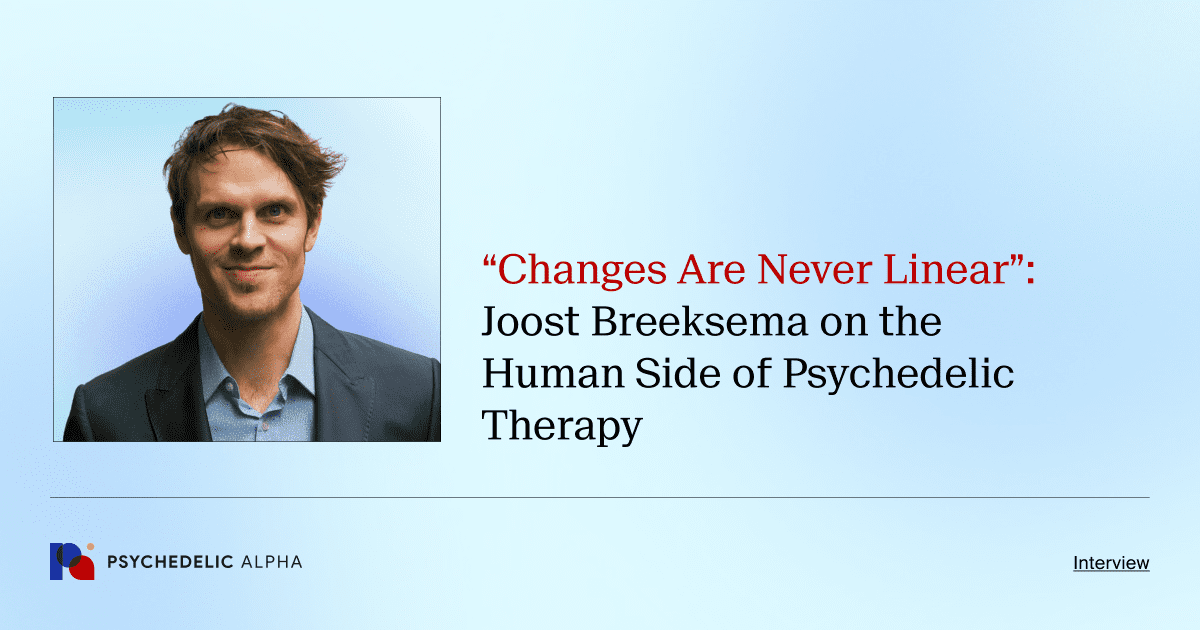
“Changes Are Never Linear”: Joost Breeksema on the Human Side of Psychedelic Therapy
Dr. Joost Breeksema is a Dutch researcher, philosopher, and postdoctoral fellow in the Department of Psychiatry at University Medical Center Groningen (UMCG). He also serves as the Executive Director of the OPEN Foundation, a non-profit based in Amsterdam that has been advancing interdisciplinary psychedelic research since 2007 and runs the popular ICPR conference. (The next instalment is in June 2026: See you there!). Breeksema is a leading voice in advocating for the recognition and exploration of patient and participant experiences and the broader social dimensions of psychedelic therapies.
In this conversation with Psychedelic Alpha’s Josh Hardman, Breeksema reflects on why qualitative research is critical for capturing the realities of patient journeys, which are often far more complex than datapoints or MADRS scores suggest, his concerns around the ‘complete medicalisation’ of psychedelics, what real-world practice might demand, and much more. The conversation ranges from microdosing and psychoplastogens to psychotherapy, alternative access models, and the training of psychedelic practitioners.
On microdosing, psychoplastogens
I think part of me is just hoping for something different with psychedelics: a new approach to treating mental health disorders that’s more holistic and that addresses deeper issues, rather than just alleviating symptoms.
Josh Hardman, Psychedelic Alpha: Recently, the largest, most rigorous study of LSD microdosing for depression, sponsored by MindBio, failed to show benefit over the control arm. You have said that you are somewhat glad it failed. Why is that?
Dr. Joost Breeksema: Well, I thought that if they had been successful and were to get an approved medication, this would have very quickly become the complete medicalisation of psychedelics: turning psychedelics into prescription antidepressants like anxiolytics, ADHD medication, etc.
I think part of me is just hoping for something different with psychedelics: a new approach to treating mental health disorders that’s more holistic and that addresses deeper issues, rather than just alleviating symptoms. Anyway, I don’t think these results will do anything to really stop people from continuing to microdose, it just won’t be commercially feasible for the treatment of a mental disorder.
‘Failed’ is an interesting perspective, too, because the study was actually successful in demonstrating that microdosing wasn’t more effective than placebo. It’s not so much that the study itself failed, and more that the company and its investors didn’t get the results they were hoping for.
Hardman: Do you feel the same about psychoplastogens, or is that separate?
Breeksema: I feel a little bit differently about psychoplastogens, and maybe that’s inconsistent because they’re both sub-perceptual and they’re targeting neural processes, rather than psychological processes or emotional processes, which is what psychedelics typically do.
I have less interest in them because I’m not as interested in brain changes. What’s interesting about psychedelics, for me, is their capacity to quickly change people’s mental states in such a dramatic way that they have completely different outlooks on life, themselves, their relations, values, how they relate to metaphysics, and parts of existence. None of that comes into play with neuroplastogens or microdoses.
What’s interesting about psychedelics, for me, is their capacity to quickly change people’s mental states in such a dramatic way that they have completely different outlooks on life, themselves, their relations, how they relate to metaphysics, and parts of existence. None of that comes into play with neuroplastogens or microdoses.
The role of non-drug support, qualitative research
Hardman: Is that something that happens to a patient independently or spontaneously upon ingesting a psychedelic, or is it something that needs to be done with a psychotherapist or a trained guide?
Breeksema: I am a firm believer that if you’re struggling with your mental health, you need to do this under the guidance of an expert; ideally in an institution that understands these treatments. It’s never going to be a quick fix.
I did some qualitative research based on interviews with a number of patients who participated in Compass Pathways’ Phase 2 trial of psilocybin for treatment-resistant depression. During a recent panel discussion, Guy Goodwin [Compass Pathways’ Chief Medical Officer] thought my outlook was too ‘gloomy’.
Editor’s note: You can read our coverage of that panel here.
What I really heard from patients was that one experience can set in motion changes, but in order to sustain them and make sure they lead to durable, positive benefits in their lives, you need a lot more. They need to be able to talk to professionals who can help them make sense of their experiences and who can redirect them to other forms of care if needed. And this is particularly true for patients who have been depressed for years.
I think this is a huge blind spot, and pharma companies don’t take qualitative research as seriously because they don’t want to talk about all these unpredictable, subjective experiences. But once you start giving psychedelics to people, and since psychedelics are inherently unpredictable, you need to be prepared to support patients when they become one with God, when they meet an alien entity, or when they have supposedly repressed memories that are impossible to verify or to validate.
Editor’s note: See our interview with Samuli Kangaslampi on the latter topic.
Hardman: You have also published qualitative work with esketamine patients. Were the findings similar in the sense that the patient journey wasn’t always linear?
I think that’s another thing that gets lost when you only talk about data points and effect sizes and reductions on the MADRS: There are human experiences behind all of those data points, and changes are never linear or predictable.
Breeksema: The approaches were really different. In the esketamine treatment approach, it was two doses per week for at least six weeks, and if patients responded they could continue treatment. Psilocybin, meanwhile, was just one dosing session with two or three preparation sessions and two integration sessions.
So, for psilocybin, patients at least had some preparation about what they could expect, but there’s a lot more that could be done in preparing patients well for esketamine.
Until I started interviewing patients, most of my colleagues didn’t have a clue about the kinds of experiences they were having, simply because they didn’t ask afterwards. They also didn’t prepare patients for these disembodied, mystical-type, or frightening, scary and confusing experiences.
I think that’s another thing that gets lost when you only talk about data points and effect sizes and reductions on the MADRS: There are human experiences behind all of those data points, and changes are never linear or predictable.
I’ve also conducted interviews with patients with severe PTSD who were treated in a Phase 2 trial sponsored by MAPS [(now Lykos Therapeutics/Resilient Pharmaceuticals)]. What we see is that two to three years down the line, people are still processing things, and in many cases, continuing therapy.
For context, this is a trial that is really well designed in terms of patient care, with a lot of contact time. Patients in the Netherlands, for example, were recruited from an expert trauma treatment centre which they remained in touch with so they had access to continued care. But even then, you treat people for a specific traumatic experience and then behind that, a lot of other stuff surfaces. It’s like: “Okay, we treated you for your nightmares and for your flashbacks, the rest is your own responsibility.”
Hardman: That makes sense, especially given how certain scales like the CAPS-5 work.
So, what’s the primary purpose of having this qualitative data and a better understanding of the patient journey? Is it to better prepare patients and improve informed consent, or do you think it could also make these therapies more effective?
Breeksema: I think it’s both, and I think that’s where the interesting conundrum of the regulators really comes in.
In order to properly evaluate both safety and efficacy, you need to understand how the drug interacts with the psychotherapeutic component.
Ideally, you need a big factorial study with lots of patients, but then it becomes so costly that even the most successful pharma companies can’t raise the money. It seems like they don’t need to, either, because the regulators will approve drug data alone.
Josh: Right. And there’s also the concern that a factorial study might complicate the narrative around the intervention. We have seen developers in the field embrace dose-response designs, attempting to show that as the dose is increased there is greater response.
We have also seen some sponsors downplay the quantity or quality of psychological support required. I recall, for example, you appearing to be frustrated by comments made by a GH Research representative at a European Medicines Agency meeting in Spring 2024. The company’s former Senior Director of Clinical Science suggested that, “because of the brevity” of the 5-MeO-DMT experience, it could be delivered without psychotherapy.
So, presumably you don’t think the duration of acute subjective effects corresponds to the amount of psychological support needed. Should we be thinking about the intensity of acute effects, instead?
Breeksema: Yes, I really believe that it’s the latter. If you listen to what people tell you about their experiences after taking short-acting psychedelics, they can be really intense and the duration can seem almost eternal. The impact can also be incredibly profound, particularly with 5-MeO-DMT experiences, which are associated with ‘ontological shock’ and which can completely change someone’s worldview. That’s not something that is easy to deal with on your own, particularly if you’re psychedelic naive and you don’t have a social environment where people are receptive to these wild experiences.
If you’re completely naive and you’re a regular person becoming one with the void and everything and nothing at the same time, it’s not an easy concept to grasp. It may be hard for people to upend their idea of what they’ve always believed.
If you’re imposing a potentially very profound experience on people, not providing the support to help them cope with it is irresponsible and unethical.
If you’re completely [psychedelic] naive and you’re … becoming one with the void and everything and nothing at the same time, it’s not an easy concept to grasp. It may be hard for people to upend their idea of what they’ve always believed.
Repeat dosing
Hardman: I wonder what the attrition is going to look like with 5-MeO-DMT, in terms of how many times a year patients are going to be willing to take it. Some of the investors and companies are modelling, for example, four or six doses a year.
Breeksema: It’s such a two-dimensional approach, and depression is such a multifaceted phenomenon.
I understand the commercial side of it, I just don’t like it. You are adding something potentially really meaningful to patients’ lives. Wouldn’t it be better therapeutically for patients to embed such an experience in a prolonged therapeutic process, where they can process these changes and understand what it means for them, if they’re happy in their job, if they find meaning in what they’re doing on a daily basis, or within their family, their relationships?
I know that’s not a formal or profitable business model, but it is a way to think about these substances that is more profound and more innovative than just seeing them as new drugs that need to be administered regularly.
It is something that does really irritate me, when investors or pharma representatives refer to ‘the Spravato model’, aiming for shorter-acting psychedelics that can be administered more cheaply and more regularly, presumably being more profitable to the companies. But does it meaningfully improve or transform what we can offer to patients? I highly doubt it.
Wouldn’t it be better therapeutically for patients to embed such an experience in a prolonged therapeutic process, where they can process these changes…? I know that’s not a formal or profitable business model, but it is a way to think about these substances that is more profound and more innovative than just seeing them as new drugs that need to be administered regularly.
A European model?
Hardman: It looks like we are seeing certain European and international groups come to the conclusion that traditional psychedelic-assisted therapy is not a neat fit with the traditional pharmaceutical model, or that companies might not launch there. So, we are seeing psychedelics access models emerge that skirt traditional marketing authorisation pathways, like in Australia but also Germany’s compassionate use model and Czechia’s limited legalisation of psilocybin’s use in medicine. But one of the key questions is reimbursement.
Breeksema: That’s where I think you need the health economics data. Without having a sense of what the gains might be across a multi-year time span, I think it will be hard to make the case. But I do think that’s where I’m a little bit optimistic. I think that, when applied properly, there is a case to be made for psychedelics, because they can address all of these life domains in parallel which will result in a good health economics picture down the line.
Some of the people that I’ve interviewed started going back to work. We know that lost productivity is a huge cost factor. If you’re feeling well enough to go back to work, that saves a lot of money down the line. So those calculations need to be made for sure.
And in terms of studies sponsored by organisations that aren’t pharmaceutical companies, we are in the process of deciding on a trial to conduct with government sponsorship in the Netherlands. The idea is that we would address a market failure by conducting a single trial on a psychedelic plus psychotherapy for a single indication. If successful, that might set a European precedent, developing the data needed to get regulatory approval and start providing it without being reliant on pharmaceutical companies.
Hardman: I had a lot of concerns around accessibility in Australia’s limited rescheduling of psilocybin and MDMA system, and I still do. Though recently both a private (Medibank) and public payor (the Department of Veterans Affairs) have moved in to begin covering psychedelic-assisted psychotherapy there. So, there are at least a couple of examples of countries doing this with reimbursement.
Breeksema: We have an example in the Netherlands as well. We legalised medical cannabis in 2000 and even have an Office of Medical Cannabis as part of the Ministry of Health, and a GMP grower (Bedrocan) in the Netherlands that produces pharmaceutical cannabis. But it’s being prescribed very rarely, because doctors and prescribers believe there’s not enough evidence, and that’s because it was approved and legalised too early. They jumped the gun.
It’s prescribed, but not nearly as often as people may be eligible, or ask for. You even have the Association for General Practitioners saying that they couldn’t recommend prescribing medical cannabis, citing a lack of evidence. That’s an issue that you may face down the line if you approve any medication without the evidence. And if it’s already approved, there’s no incentive for anyone to conduct the clinical studies needed to generate the evidence that professionals might want to see.
[As part of PsyPal], one of the things that we’re doing at the OPEN Foundation is providing support groups led by volunteer facilitators. It’s meant as a low threshold support group for patients when they’ve exited the clinical trial phase of PsyPal. It’s so they have a point of contact with other patients who’ve been through the same trial
Non-drug support in PsyPal
Hardman: On a separate note, I know you’re involved in PsyPal, the EU-funded study of psilocybin in several palliative care contexts. What types of non-drug support are you providing patients with, and what qualitative data are you collecting?
Editor’s note: Read our interview with Robert Schoevers for more on PsyPal.
Breeksema: One of the things we’re doing at the OPEN Foundation is providing support groups led by volunteer facilitators. It’s meant as a low threshold support group for patients when they exit the clinical trial phase of PsyPal, so they have a point of contact with other patients who’ve been through the same trial, who may have the same struggles, whether they’re related to receiving psilocybin, having a terminal diagnosis, or having been part of a trial.
We’ve trained facilitators in all four countries that are participating in PsyPal, but as we’re just seeing the first people being treated with psilocybin therapy, we don’t have any data yet.
As well as peer support groups, PsyPal is also offering a digital care package, which is basically an app where patients have access to all kinds of exercises, tools and resources to help them stay with the experience and make sense of it.
This is really a benefit of getting public funding for such a trial. You hardly ever see this as part of an industry-sponsored trial.
Hardman: Presumably there are going to be a lot of publications that come out of this?
Breeksema: It takes a while, but yes, we’re planning lots of different qualitative studies with patients about their experiences receiving aftercare, peer support, but also with study therapists to really understand what worked, what didn’t work, how they manage challenging situations, and what they would have done differently with the caregivers.
That’s an important part that hardly ever receives any attention. Getting a close perspective from loved ones about how their family members are doing after participating in the trial, I think that will give us a lot of valuable information as well.
If someone has a life-changing experience and they are somehow able to integrate that well into their lives, that doesn’t mean that their loved ones, their partners, or their family members are also able to follow them in that. Especially if they haven’t been involved in the process very closely. It can be very alienating or isolating for them as well.
When you get to real-world implementation, I think you get more complex patients and more difficult cases, and that’s where I think the standard training courses that are offered by companies won’t suffice.
OPEN Foundation’s training program
Hardman: I’m really looking forward to those future publications. Learnings from study therapists will surely be very useful, especially for the purposes of training future psychedelic practitioners. I know OPEN Foundation has a training course, ADEPT: can you tell us a little about that before we wrap up?
Breeksema: ADEPT grew out of a concern that existing training models don’t fully prepare therapists for the realities of clinical practice beyond controlled trials, and that it may lead to harm that is preventable. There is a big gap between how therapists are trained for trials run by drug companies, and the comprehensive model we offer with ADEPT.
When you get to real-world implementation, we’re likely to start seeing more complex patients and more difficult cases, and that’s where I think the standard training courses that are offered by companies won’t suffice. Working with real patients requires therapists who are deeply trained, ethically grounded, and able to accompany people through altered states skillfully, with care, sensitivity, and good judgment.
One of the upsides of living and working in the Netherlands, is that psilocybin truffles are legal. This enables us to offer experiential learning as part of their training; therapists can have their own experiences with psilocybin, and gain supervised experience guiding others. Small, subtle things can have a big impact on how someone’s experience unfolds, and this is something that is hard to properly understand if you haven’t had that perspective yourself.
This connects to the ongoing debate about whether therapists need personal experience with non-ordinary states. There are studies underway in Australia and Switzerland that examine whether therapist self-experience affects outcomes, which will be extremely informative.
For now, long-standing clinical wisdom and common sense suggests that it matters. ADEPT is our attempt to really integrate that insight in training the future experts in psychedelic therapy. After all, in most areas of psychotherapy training, it is taken for granted that practitioners undergo the very modality they later offer to patients, and if we agree that psychedelic therapy is psychotherapy, which is what ADEPT stands for, this should be no exception.
Join thousands of psychedelics insiders
Get the weekly psychedelic medicine briefing.
A free weekly digest covering trials, regulation, policy, and access.
By signing up, you agree to our privacy policy. You can unsubscribe at any time.