No Questions Asked: FDA’s Psychedelics Public Hearing
Audio versions of our articles are generated using artificial intelligence, though the voice model is trained on that of our Editor, Josh Hardman.
Yesterday, some three hundred people convened at FDA’s White Oak Campus in Maryland, on the outskirts of Washington, D.C., to participate in the agency’s four-hour public hearing concerning the potential future therapeutic use of psychedelic drugs. A further one thousand viewers tuned in to a live stream.
These events, dubbed ‘Part 15’ public hearings, are by no means a common affair. In fact, FDA has convened just two such meetings since 2020. It arranges these hearings, which are informal in nature, at its discretion, generally doing so to solicit input on matters that it deems to be “in the public interest”.
Throughout the course of the afternoon, around eighty individuals provided two-minute comments on topics including provider training and credentialing, the promotion of patient safety, considerations for access, and best practices for data collection and standardisation. Around half of the speakers attended in person, with the remainder appearing via video link.
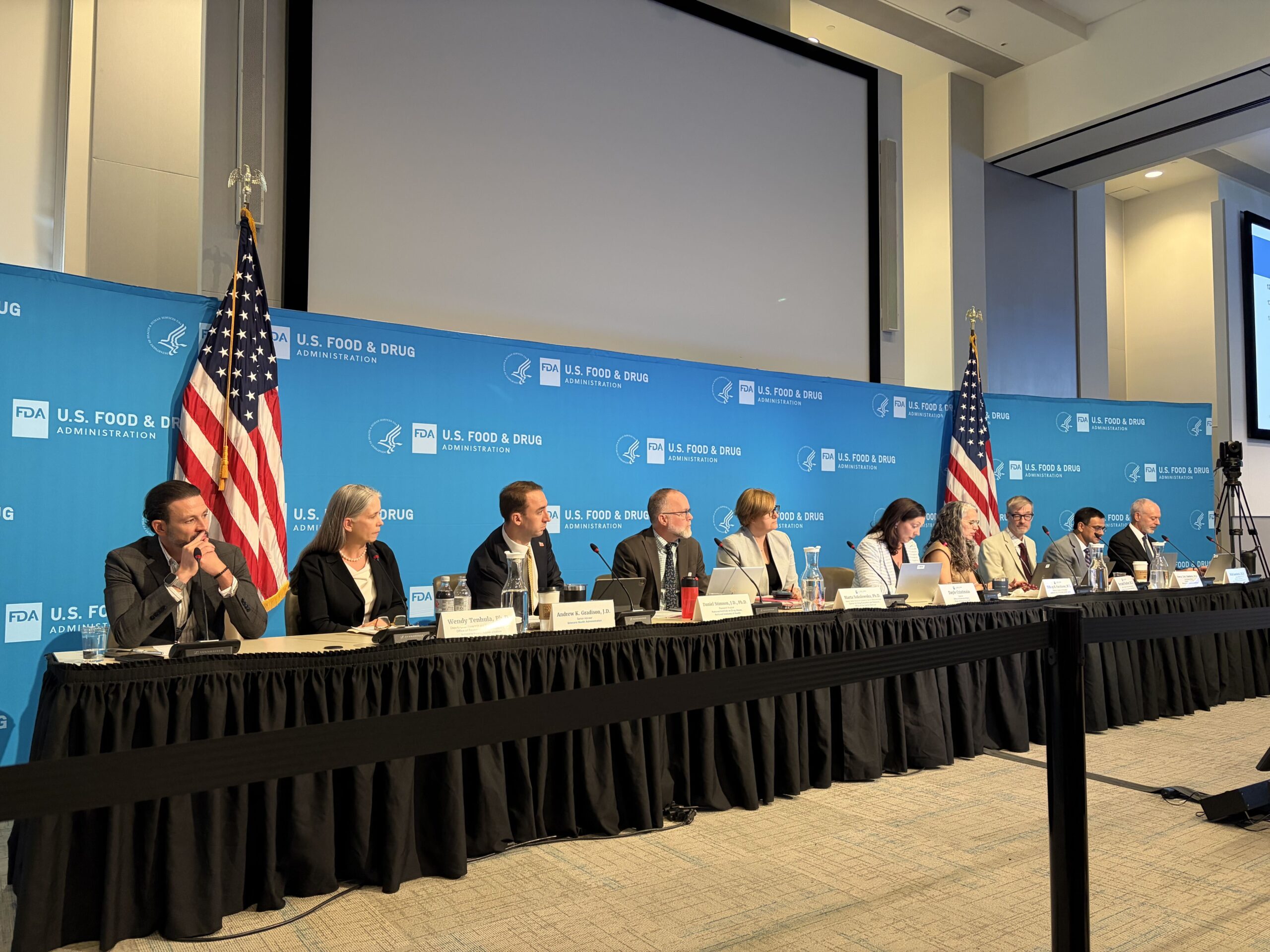
Their comments were heard by a panel of federal staffers, with representatives from FDA as well as NIDA, VA, SAMHSA, and ARPA-H.
The range of comments was broad, though there was nothing raised during the hearing that was particularly unexpected or novel. Many of the topics were well-trodden ground, for those within the field, at least.
One plea of sorts that was repeatedly raised by commenters was for the agency, and its federal partners, to view psychedelics not as drugs that work alone, but as part of a broader therapeutic intervention or package.
Commenters like Lawrence Leeman of the University of New Mexico, for example, stressed that the intervention should be conceptualised as psychedelic-assisted therapy, with emphasis on things like preparation and integration, while psychologist Geoff Bathje said that he has been “disappointed to see the FDA minimise the importance of the therapeutic relationship in psychedelic research for the sake of isolating drug effects in clinical trials.” FDA does not regulate psychotherapy.
While this was a common theme, it was not universal.
Peter Hendricks, a professor at the University of Alabama at Birmingham, said that requiring psychotherapy in all models of psychedelic treatments “would fall hardest on the people least able to find care elsewhere”, noting that patients in his trials are disproportionately low-income and uninsured. He also pointed out that the contribution of psychotherapy to the efficacy of psychedelic interventions has not yet been characterised, as noted in FDA’s own guidance.
Instead of a blanket requirement, Hendricks recommended that product labels specify which of three treatment models the evidence supports: safety monitoring, psychological support, or psychotherapy.
Labelling is likely to have implications for reimbursement, as Radial’s Amna Aslam pointed out later in the hearing. “Insurers build the coverage rules from the label”, she said, urging FDA to “write the label with payors in mind.”
These sorts of comments tied into another recurring theme: how restrictive any strictures around approvals, like REMS programs, should be.
Multiple speakers urged the agency to devise REMS on a case-by-case basis, as opposed to applying a single REMS template to the class. One such commenter was Lawrence Goldkind, himself a former FDA staffer, who asked the agency to tailor labelling and REMS to each specific drug. Speakers who expressed this opinion will likely be gratified, for we understand a shared REMS is very unlikely, at least for now.
Other comments emphasised that if these elements are too complex, access could suffer. Laurel Kilgour, representing the Psychedelic Bar Association, said that “an overly zealous risk mitigation framework can undermine safety by pushing people toward underground alternatives with no oversight or foreclosing access altogether”.
At the more laissez-faire end of the spectrum, Christian Reed, a retired Green Beret who volunteers for a veterans organisation and spoke on behalf of at-home ketamine company Mindbloom, appeared to suggest that psychedelics could be administered outside of clinics. “As you weigh treatments for approval, I’d ask you to weigh access and feasibility as seriously as safety”, he said to the panel. “That means not locking this inside clinics in a handful of major cities and not weighing it down with so much overhead that insurers won’t cover.”
But Eddie Jacobs, a researcher at Johns Hopkins, took a more conservative approach, citing gaps in the characterisation of psychedelics’ safety profiles. “We recommend an initial safety floor anchored closely to the trial context”, he told the panel, acknowledging that this could limit access in the short term and burden providers. “But it’s better to start with stronger protections and adjust them as the evidence accumulates,” he added.
Jacobs was not the only one to call for a somewhat cautious rollout.
Amber Barnato, director of the Dartmouth Institute for Health Policy and Clinical Practice, who is also a certified psychedelic-assisted therapy facilitator, said that while she views FDA approval of psychedelics “ethically defensible”, the evidence base is of low certainty. “It’s drawn from small, functionally unblinded trials”, she told the panel.
Her prescription is to run ongoing comparative effectiveness studies, with data collected via souped-up registries that include standardised elements like patients’ intentions, expectations, and an account of preparation and integration. At present, Barnato said, these are collected inconsistently across trials.
Susan Taymor Sagy offered a more direct voice of caution, telling the panel that her 21-year-old daughter died following psychedelic use. Public education cannot be an afterthought, she told the federal representatives, noting that FDA approval of a psychedelic would “carry enormous cultural weight” and should be accompanied by such an effort.
Beyond cautionary comments, the hearing featured just one outright critic: Kevin Sabet, a well-known voice in the drug policy world. Though a draft agenda seen by Psychedelic Alpha had him set to attend in person, Sabet joined the hearing virtually.
He began his comment by noting that he has no disclosures to make, using the opener to take a jab at other speakers. “I can probably confidently say that I’m one of the few here without a financial interest in the expanded use of psychedelics”, he said, “which I think is something we should absolutely be concerned about.”
“Psychedelics should earn approval the way any other class of drug does, through science and trials, not politics or podcasters”, Sabet went on. He then critiqued the quality of psychedelic studies, describing them as having “very small sample sizes” and “methodological issues”.
He also appeared to take aim at Americans for Ibogaine co-founder Bryan Hubbard. “I remain very concerned that we’re hearing advocates, even some of the most popular ones, the ones standing in the Oval Office, invoking violent revolution if psychedelics are not approved”, Sabet said, presumably referring to a clip circulated by Hubbard himself in which he quotes John F. Kennedy’s famous Cold War quip: “Those who make peaceful revolution impossible will make violent revolution inevitable”. Hubbard was speaking about ibogaine at the Disabled American Veterans’ national convention last month.
These voices of caution and critique, however, were vastly outnumbered by positive comments, with the whole affair feeling somewhat self-congratulatory at times. Dayle Cristinzio, who moderated the hearing, twice asked the audience not to applaud after comments, though a small number couldn’t help but clap sporadically throughout the afternoon.
Indeed, the vast majority of the Great Room, which was half full, was occupied by people from within the psychedelics field, and most could be described as psychedelics advocates. Such uniform support is not common for these types of meetings, with previous Part 15 hearings on topics like the regulation of homoeopathic products and products containing cannabis-derived compounds featuring much more varied audiences and commenters, in terms of their views on the respective subjects.
While many were suited and booted for the occasion, the quirkiness of the psychedelics field managed to sneak through on several occasions.
At one point, several members of the federal panel smirked as Justice Leak, an actor and entrepreneur, asked them to “imagine walking into this room on LSD”. He then recounted how he gave his mother, who has Alzheimer’s, high doses of psilocybin, which he says led her to sing and dance in her kitchen.
On another occasion, James Hosobe, a biomedical researcher at the Arizona Department of Health Services, vividly recounted Humphrey Osmond’s coining of the term ‘psychedelic’, and complained about a lack of precision in how the various molecules under discussion are defined.
Other reminders of the very ‘psychedelic’ group gathered in the room included references to the long history of psychedelic use in various cultures around the world. Myco-Method’s Shasta Winn, for example, complained that the “long sacramental history” of psychedelics is invoked by some as a source of legitimacy, but that the agency made it clear that it did not want to hear from the public about religious and ceremonial use as part of the hearing.
Elsewhere, Raymond Turpin of The Pearl Institute appealed to another well-known concept in the psychedelics field. During his remarks, he said that training programs should feature “the cornerstone concept of internal [sic] healing intelligence”, which features prominently in the MAPS MDMA model. The topic of experiential training, which groups like MAPS have sought to offer, was also raised by multiple commenters.
While the vast majority of comments focused on psychedelics’ potential therapeutic use for mental health disorders, a few sought to broaden the scope to go beyond psychiatry.
Eileen Brewer of various affiliations including Clusterbusters, Lynn Watkins of the Psychedelics and Pain Association, and Richard Langford of Cy Biopharma, for example, discussed the potential of psychedelics for pain, with Brewer calling for FDA’s guidance to contemplate other models of dosing that might be more appropriate for indications like cluster headache.
Cochlear implant recipient Dennis Chien, meanwhile, suggested that psychedelics may help catalyse the learning curve and ultimate performance of patients with the devices.
While some smaller psychedelic drug developers spoke at the hearing, Compass Pathways appeared to give up its spot on the agenda, with its Senior Director of Pharmacovigilance and Clinical Safety not providing comments on the day.
Pα: Beyond the contents of the public comments, we had hoped to glean the agency’s and its federal partners’ priorities and curiosities via follow-up questions it could have asked of speakers.
A review of prior Part 15 hearings shows that back-and-forth between the panel and commenters is a prominent element of proceedings. It was also envisaged in both FDA’s agenda for yesterday’s meeting and by the agency’s AV team, who had placed Sennheiser microphones in front of each of the nine panellists. On the day itself, speakers rattled through the agenda ahead of schedule, with time to spare.
But all that setup was in vain, ultimately, with not a single question asked, or word uttered, by any of the federal panellists, save for Marta Sokolowska’s prepared remarks at the opening.
Despite the available time in the agenda, the format of the event was not conducive to such exchanges. Commenters’ contributions were too brief to provide or invite substantive discussion, and the conveyor belt of speakers created an air of urgency.
In terms of the comments themselves, there were no surprises, with the majority of speakers discussing topics and making recommendations that are well known to those within the field, if not the federal staffers present on the day. Some speakers used their two-minute slot as an opportunity to hawk their wares, pitching accreditation or credentialing systems, training programs, drug supply capabilities, and drug development candidates.
With almost all commenters speaking positively about psychedelics through comments that were so brief as to lack any real substance, one might be left wondering what the purpose of the hearing was. It could be viewed as a spectacle of sorts; an effort to demonstrate that the various agencies are listening to the public (or, the psychedelics field) and are acting on April’s executive order.
Still, the very act of convening a Part 15 hearing, which is by no means a routine event, demonstrates the agency’s continued close interest in the topic of psychedelics, and it felt as if the drugs’ entrance into the U.S. medical model is a fait accompli.
Written comments can be submitted to FDA via a public docket, which closes on October 5th.
Josh Hardman
Josh has been writing, talking and working on the business, science and policy of psychedelics since he launched Psychedelic Alpha in early 2020.
Join thousands of psychedelics insiders
Get the weekly psychedelic medicine briefing.
A free weekly digest covering trials, regulation, policy, and access.
By signing up, you agree to our privacy policy. You can unsubscribe at any time.