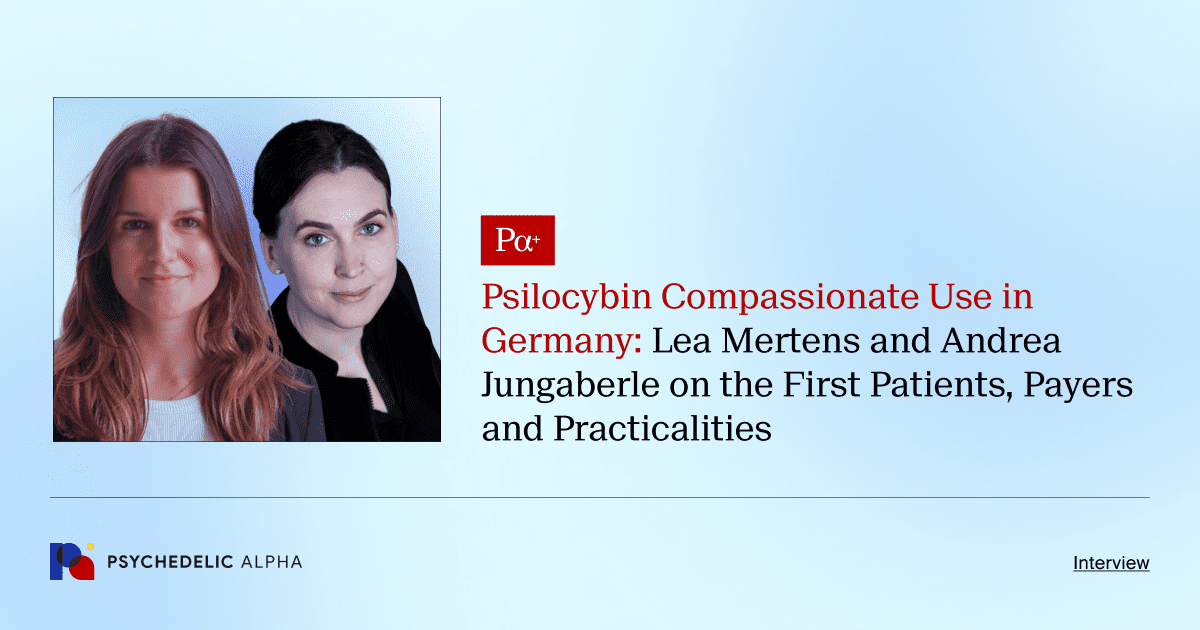
Psilocybin Compassionate Use in Germany: Lea Mertens and Andrea Jungaberle on the First Patients, Payers and Practicalities
Last summer, Germany’s medicines regulator quietly green-lit a psilocybin compassionate use program, the first such pathway in the European Union (see Germany Establishes EU’s First Psilocybin Compassionate Access Program). Two centres are permitted to offer psilocybin dosing at present: OVID Clinic Berlin, a private clinic in the nation’s capital, and the Central Institute of Mental Health (CIMH) in Mannheim, a public hospital.
On the final day of the Interdisciplinary Conference on Psychedelic Research (ICPR) in Haarlem, the Netherlands, our Editor Josh Hardman sat down with two of the people at the centre of the project: Lea Mertens, a researcher and psychotherapist who is first-author on the two primary publications associated with the EPIsoDE study (one in JAMA Psychiatry, and another in Psychotherapy and Psychosomatics), which formed the basis for the compassionate use program; and Dr. Andrea Jungaberle, a medical doctor and psychotherapist who co-leads OVID Clinic Berlin with Dr. Gerhard Gründer, with whom Mertens also works closely.
Here, they discuss the experiences of the first few patients to receive psilocybin under the program at OVID, progress in securing coverage from public and private German insurers, Mannheim’s list of 700 patients who have expressed interest, and the flexibilities the compassionate use model affords compared with clinical trials.
***
Josh Hardman, Psychedelic Alpha: So, you have two quite different sites, right?
Lea Mertens: Yes, we have two centres. Andrea is at OVID in Berlin, and we’re a big public hospital, so it’s quite different; it’s a big machine. We are at the point where we are just implementing the program in our hospital, which we are hoping to do in an outpatient setting. We have started screening people.
Hardman: Has it been tough getting buy-in from colleagues at Mannheim, or have most people been open to it?
Mertens: They're open to it, it’s just a large hospital and more of a rigid system, so it’s just trying to find the proper and optimal way to actually do it, and to document it. It’s got to be covered by the public insurance.
Hardman: So, the goal is for all of the compassionate use treatment to be covered by public insurance at your centre?
Mertens: Yes. And it would be covered already if you do it on an inpatient basis, because then it would just fall under the normal daily copay that you get anyway, no matter what treatment the person receives. But doing it inpatient has other challenges: you need to have a bed available, and so on. That’s quite difficult, because we’re a general public psychiatric hospital covering the whole area of Mannheim.
We’re currently awaiting approval from BfArM [(Germany’s drug approval body)] for also doing it outpatient. We believe the basis for that is there, based on the existing studies. If that approval comes, we would most likely do it on an outpatient basis, because it’s easier to do and there’s less risk for public insurance to question it.
Hardman: That's very interesting. One of the criticisms of similar programs in the U.S. is that it’s not always accessible for patients who do not have private health insurance.
Andrea Jungaberle: Around 10% of the general population in Germany have private insurance, because all public servants are on private insurance, for example. The goal we’ve reached now at OVID is that, because we do it as a stay at the day clinic, we also go via copay, so nobody pays for the compassionate use element if they are on private insurance. They pay for the day clinic stay, and the insurance covers it.
We actually got the largest German private insurer to kind of fast track us, so we have an agreement with them that we will get the approval within a week if it’s granted, ...
Join Today
Independent data-driven reporting, analysis and commentary on the psychedelics space: from business and drug development through to policy reform and research.
- Regular Bulletins featuring news, analysis, and research
- Articles and deep dives across psychedelic drug development, policy, and research
- Exclusive interviews with researchers, executives, and policymakers
- Bespoke resources and tools including the Psychedelic Bill Tracker
- Quarterly video briefings and slide decks