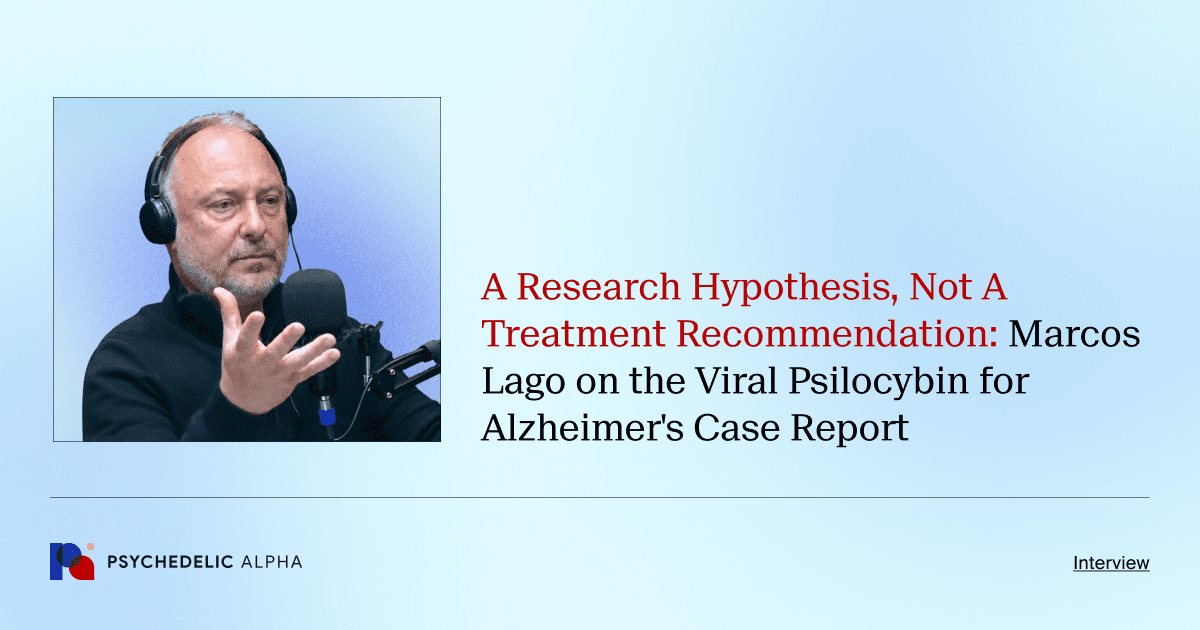
A Research Hypothesis, Not A Treatment Recommendation: Marcos Lago on the Viral Psilocybin for Alzheimer's Case Report
A case report published in Frontiers in Neuroscience late last month (Lago et al., 2026) caused quite a stir, with various media outlets and psychedelics advocates hailing it as showing great promise.
The article describes a woman in her 80s who has had Alzheimer’s for a decade, including five years of marked hypofunction and largely monosyllabic speech. At baseline, the authors note, she had chronic urinary incontinence, dysphagia, dependent mobility, flat affect, and severely reduced spontaneous communication.
After receiving 5 grams of psilocybin-containing mushrooms of the ‘Enigma’ strain, she experienced acute autonomic activation, suspected hyperthermia, profuse sweating, and a prolonged deep sleep-like state, the case report states. The next day, it goes on, “spontaneous autobiographical speech emerged.” Functional gains followed over subsequent days and weeks, they add, including restored urinary continence, improved walking, autonomous dressing, greater emotional responsiveness, and sustained social interaction.
A second dosing session using 3 grams of psilocybin-containing mushrooms is also described, leading to “greater expressivity, improved facial mimicry, spontaneous humor, emotionally valenced autobiographical imagery, and increased agility while walking.”
The case has attracted excitable social media posts by some psychedelics advocates as well as splashy headlines from the media, including “Alzheimer’s patient gets back speech, bladder control and memory in groundbreaking drug trial” (New York Post), “Woman with Alzheimer’s starts conversing again after taking psilocybin” (New Scientist), and “The natural compound that temporarily reverses advanced dementia symptoms” (Independent). (It was not a trial, the patient was perhaps better described as being administered psilocybin rather than ‘taking’ it, and there is far from enough evidence to proclaim a temporary reversal of dementia symptoms.)
Keen to look beyond the headlines, we spoke with several experts about the case report and the broader threads it pulls on, from ethics to clinical-trial experience with psilocybin in patients with Alzheimer’s disease. Those perspectives will feature in our next Bulletin.
We also spoke with Marcos Lago, the São Paulo-based psychiatrist and first author of the case report. The patient was dosed under his supervision at his private practice, where he says he has administered psilocybin to 200 people despite the “complex” legal context in Brazil. He is also associated with a religious association named Associação Cruz de Ankh, which may offer some Constitutional protections for ceremonial practices, perhaps including the use of psilocybin.
Here, we look closer at the case and the circumstances surrounding the buzzy case report, according to Lago, the treating psychiatrist.
Josh Hardman, Psychedelic Alpha: Could you share a bit about yourself and your practice?
Marcos Lago: I am a psychiatrist based in São Paulo, Brazil, working in private clinical practice. My professional interests include psychiatry, consciousness, contemplative practices, spirituality, and the possible relationship between altered states of consciousness and human functioning.
I am also involved with Associação Cruz de Ankh, a legally constituted Brazilian religious association dedicated to philosophical inquiry, spirituality, self-knowledge, and the study of consciousness.
It is important to distinguish my conventional psychiatric work from the association’s philosophical and ceremonial activities. They overlap in my intellectual interests, but they should not automatically be described as the same type of practice.
Hardman: How many people have you dosed with psilocybin?
Lago: I have supervised approximately 400 sessions involving around 200 adult participants.
Most participants were not undertaking conventional medical treatment. The majority of sessions occurred within a philosophical and contemplative framework focused on self-knowledge, meditation, personal meaning, and the examination of consciousness.
Some participants also had depression, anxiety, problematic substance use, or other psychological difficulties. However, these observations do not constitute controlled clinical evidence, and I do not present the approximately 200 participants as a therapeutic cohort.
The sessions were structured around preparation, supervision, observation, and subsequent reflection or integration. The approach is individualised rather than a rigid protocol.
In general, the first experience is the most intensive. It is conceptually informed by the high-dose model used in international psilocybin research. However, dried mushrooms are not pharmaceutical psilocybin, their potency is variable, and mushroom weight cannot be converted reliably into a dose of purified psilocybin.
Subsequent sessions generally use progressively lower intensity. The objective is not for participants to depend on increasingly powerful psychedelic experiences. It is the opposite: we aim to help them develop the ability to enter contemplative and meditative states with less pharmacological assistance over time.
In my own experience, after approximately five years of contemplative training, only a very small amount is required to facilitate a state that previously required a much more intense session. I regard that reduction, rather than escalation, as evidence of learning.
The frequency of sessions has varied considerably over time. This is not organised as a high-volume or standardised treatment service. It is a specialised and distinct part of my work rather than the entirety of my psychiatric practice.
Hardman: What is the legal status of psilocybin in Brazil?
Lago: The legal situation is complex and should not be oversimplified.
Psilocybin and psilocin are listed by the Brazilian health authority, Anvisa, as proscribed substances. Psilocybin is not an approved standard medical treatment in Brazil.
At the same time, the Brazilian Constitution protects freedom of conscience, belief, religious practice, and religious liturgy. Associação Cruz de Ankh understands its philosophical and ceremonial activities within that constitutional framework.
However, I do not claim that religious freedom provides a blanket or legally uncontested exemption from all drug-control or health regulations. The interaction between constitutional religious freedom, controlled-substance legislation, medical regulation, and ceremonial practice remains legally sensitive.
For that reason, I would distinguish carefully between:
- approved medical treatment;
- scientific research;
- private psychiatric care; and
- philosophical or religious practice.
They are not interchangeable categories.
Hardman: Is psilocybin accepted as therapeutically useful by your medical colleagues?
Lago: It is not accepted as a standard treatment in Brazilian psychiatry.
The response among colleagues varies. Some are scientifically interested, particularly because of the growing international literature on depression, end-of-life distress, addiction, and other conditions. Others remain skeptical or strongly opposed, often because the evidence is still limited, the substance is legally restricted, and unregulated use carries clear risks.
My own position is that neither enthusiasm nor rejection should replace evidence. The field requires better-designed studies, standardised substances, defined safety procedures, objective outcomes, and long-term follow-up.
The Alzheimer’s case report should be understood in that context. It is not proof of treatment efficacy. It is an unusual observation that raises a legitimate research question.
Hardman: Turning now to the Alzheimer’s patient described in the case report, who initiated the conversation around psilocybin, or first had the idea?
Lago: The initial discussion was initiated by the son of the patient and co-author Joe Xavier Simonet.
The decision was subsequently discussed among those involved in the patient’s care, including the potential risks, the absence of established evidence in advanced Alzheimer’s disease, and the exploratory nature of the intervention.
It is important to distinguish the origin of the idea from the clinical responsibility for evaluating and supervising the intervention. The final decision was made only after discussion with the patient’s legal guardian and those directly responsible for her care.
Hardman: What was the context for the dosing sessions? For example, was it at the patient’s home or a private practice?
Lago: All dosing sessions were conducted at my private medical practice in São Paulo, not at the patient’s home or in a hospital or academic research unit.
The setting was prepared to provide privacy, continuous supervision, physical comfort, and a low-stimulation environment. The patient was accompanied by people familiar with her condition and behaviour.
This was private clinical care, not a formal clinical trial.
Hardman: What was the follow-up length following the second dose and for adverse effects?
Lago: The patient was observed continuously throughout each acute session and during the immediate recovery period.
The usual interval between sessions was approximately one month. During that period, her clinical condition, functional changes, and any possible adverse effects were followed through direct clinical assessment and reports from her son, legal guardian, and caregivers.
There was no predefined trial endpoint or formal adverse-event surveillance protocol, since this was not a prospective clinical study. No severe or persistent adverse effects were identified during the interval following the second session.
The adverse effects observed were mainly acute and self-limited. Nevertheless, the absence of formal physiological monitoring and standardised adverse-event scales is an important limitation of the report.
Hardman: Were the clinical observations based solely on the authors’ assessments, or were caregivers and the legal guardian involved?
Lago: The observations were not based solely on the authors’ assessments.
They combined direct clinical observation during the sessions, subsequent clinical contact, and reports from the patient’s son, who was also her legal guardian and primary caregiver, as well as from other caregivers familiar with her baseline condition.
This was particularly important because many of the reported changes occurred in daily life between sessions, including spontaneous speech, facial expression, social engagement, initiative, mobility, dressing, continence, and contextual awareness.
However, there were no blinded independent raters, standardised cognitive scales, or controlled outcome assessments. The findings must therefore be interpreted as caregiver-supported clinical observations.
Hardman: Were discussions about consent held with the patient’s legal guardian?
Lago: Yes.
Because of the severity of her cognitive impairment, the patient was not considered capable of providing full independent informed consent.
The exploratory nature of the intervention, the lack of established evidence of efficacy in advanced Alzheimer’s disease, and the potential risks were discussed with her son and legal guardian, who authorised the intervention.
The patient’s behaviour, comfort, and willingness to participate were also observed throughout the process. The intervention would not have proceeded or continued in the presence of active resistance or significant distress. This behavioural assent, however, should not be confused with full informed consent.
Separate written consent was obtained from the legal guardian for publication of the patient’s clinical information.
Hardman: Do you plan to redose this patient, or others, in the future?
Lago: The published report describes the first two sessions. The patient subsequently underwent two additional supervised sessions at approximately one-month intervals, bringing the total to four sessions. The later sessions used a lower amount than the initial session.
These subsequent observations were not included in the published case report and should not be interpreted as controlled clinical-trial data.
Any future session involving this patient would be decided individually, based on her current clinical condition, previous tolerability, potential risks, and the judgment of those responsible for her care.
We are interested in studying similar cases more systematically. However, we are not currently recruiting participants for a clinical trial or offering an established treatment protocol.
The appropriate next step would be a prospective, ethics-approved study with standardised product characterisation, predefined safety criteria, objective outcome measures, independent assessment, and longer-term follow-up.
The purpose of the case report was to document an unusual clinical observation and generate a research hypothesis, not to establish a treatment recommendation.
Hardman: Can we dive a little deeper into your decision to use lower doses in those subsequent sessions?
Lago: The initial 5-gram amount produced a prolonged and clinically intense session, followed by meaningful changes across several functional domains. Since substantial effects had already been observed, there was no reason to assume that repeating the same amount would provide additional benefit. Remember that the Johns Hopkins trials and others all over the world are being done with 30 mg of psilocybin, mushrooms contain, on average, 0.6% of psilocybin, hence 5 grams * 0,6% equals 30 mg. Nothing different from the hospital trials.
The subsequent sessions therefore used 3 grams of dried psilocybin-containing mushrooms. The intention was to reduce the overall intensity and potential physiological burden while observing whether the functional effects could be reproduced or maintained.
This was a cautious clinical decision rather than the result of an established dose-response model. Because the mushroom material was not chemically standardized, the amounts should not be interpreted as precise pharmaceutical psilocybin doses.
Hardman: What do you think of the reception to this case report, including in the media?
Lago: The response has been broader and faster than I expected. The case has received international attention from scientific, medical, psychedelic, and general-interest media.
Much of the coverage has appropriately emphasised that this is a single observational case and not evidence of an established treatment. Some reports have also understood what I consider the central scientific point: the observation raises the possibility that meaningful residual functional capacity may remain accessible even in advanced neurodegeneration.
Other coverage has been more sensationalised. In particular, some reports have confused the weight of dried mushrooms with the dose of purified psilocybin, exaggerated the conclusions, or framed the case primarily as a provocative anecdote.
Both uncritical enthusiasm and automatic dismissal are scientifically unhelpful. The case does not prove efficacy, but neither should an unusual, documented observation be ignored merely because it challenges expectations. The appropriate response is independent investigation.
Join thousands of psychedelics insiders
Get the weekly psychedelic medicine briefing.
A free weekly digest covering trials, regulation, policy, and access.
By signing up, you agree to our privacy policy. You can unsubscribe at any time.