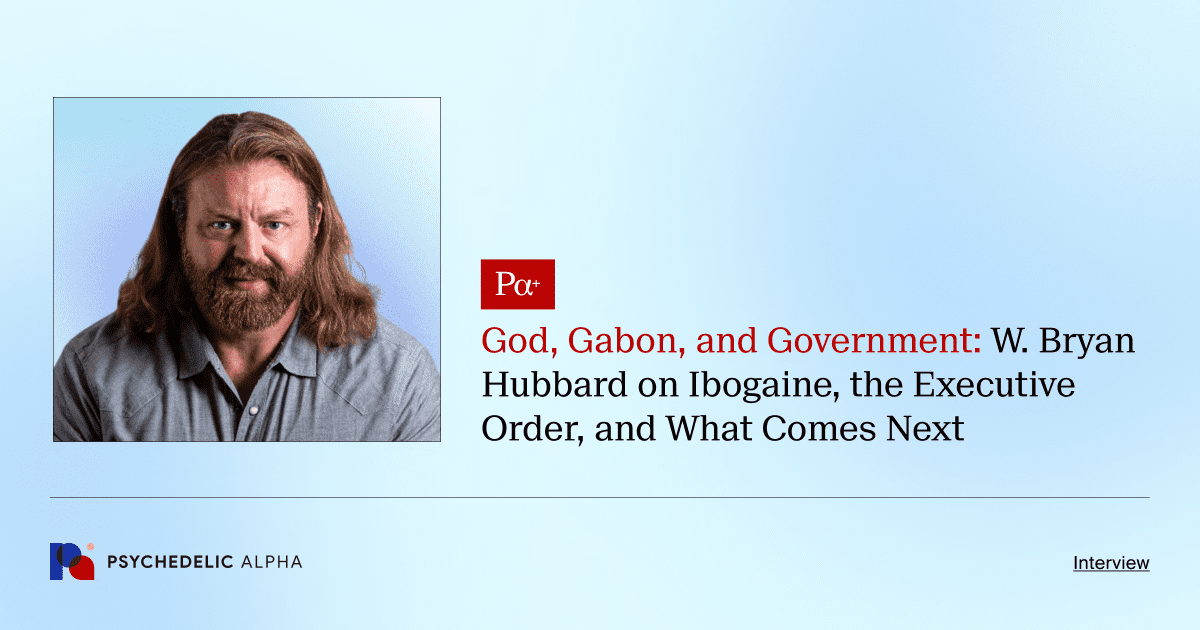
God, Gabon, and Government: W. Bryan Hubbard on Ibogaine, the Executive Order, and What Comes Next
- From Executive Order to Action: Timelines
- Right to Try
- Right to Pay?
- That 80% Figure
- Translatability to a Broader Patient Population
- Mechanism of Action
- Hubbard’s Ibogaine Experiences
- The Centrality of Spirituality; Non-Medical Use
- Relations with Gabon, Other Ibogaine Advocates
- The Political Opening; Perry’s Oval Office Absence
- Concerns Re: Clinics in Mexico
- Closing Question
Earlier this week, I sat down with W. Bryan Hubbard, the CEO of Americans for Ibogaine and a man who needs little introduction these days. Two weeks ago, he stood behind President Donald Trump and next to Joe Rogan as a psychedelics-focused executive order (EO) that he played a significant part in orchestrating was signed.
We spoke at the National Council for Mental Wellbeing’s 2026 meeting (‘NatCon’) in Denver, Colorado, where there were three panels on psychedelics. Hubbard sat on one of those panels, titled ‘The Psychedelic No One Knows About’, which might be less true today than ever before.
When we chatted later in the day, I asked Hubbard to spare us his trademark ibogaine pitch, for you, a Psychedelic Alpha reader, are surely familiar with it by now. Instead, I sought to dive a little deeper, unpacking the next steps post-EO, how accessible ibogaine treatment can truly be, Hubbard’s views around the drug’s mechanism of action, the role of spirituality, relations with Gabon, the extent of the present political opening, and more.
As we have highlighted in our past reporting, Hubbard is wont to invoke revolutionary moments from history. In our pre-EO reporting, where we said that ibogaine advocates were “courting Trump, via Rogan”, we noted his discussion of the French Revolution on the Joe Rogan podcast that aired in early April. “It was quite a surprising invocation, given the company”, we wrote at the time.
Indeed, despite assuring audiences on podcasts like Rogan’s and Theo Von’s, and in conservative legislatures across the U.S., that his family has been Republican going back to the Civil War, Hubbard told me that he is keen to reach ‘more liberal audiences’, as well as people of colour and the LGBTQ community.
It certainly seems that the ibogaine advocate is willing to tailor his message to whoever will hear him out. At NatCon, where attendees include safety net mental and behavioural care providers, with a strong substance use disorder focus, Hubbard highlighted a 15-minute segment that had aired on Oprah just days earlier, in which he featured.
It remains unclear, however, whether Hubbard and co. will be able to balance both audiences, with his public condemnation of ‘debaucherous, hedonistic’ uses of psychedelics and downplaying of social determinants of health, as well as his foregrounding of certain rhetoric like ‘spiritual warfar’, unlikely to cut through to liberals. And yet his opposition to the War on Drugs and associated prohibitionist attitudes and policies surely will cut through to many on the left, and has somehow not drawn too much ire from Republicans, even when proclaimed in the Oval Office.
It’s also unclear, as yet, how the therapeutic promise of ibogaine for conditions like opioid use disorder (OUD) will translate from a somewhat specific population of early adopters who travel to clinics in places like Mexico into a more general patient population.
And yet another area of uncertainty is the extent to which industry will become involved in the emerging federal-state ibogaine program, which Hubbard describes as a ‘national civics project’. Indeed, no drug developer was willing or able to meet the demands of the Texas match-funding opportunity. “The…reality is that ibogaine is not patentable”, Hubbard said during his panel earlier in the day. When combined with a potential scenario in which people take the drug just two or three times over the course of their life, he went on, the commercial profile is unattractive as an investment prospect.
In other interviews, Hubbard has gone on tirades about Kentucky Governor Andy Beshear, who put an end to his plans to carve out $42M from state opioid abatement funds. He has also bemoaned potential blockers to accelerating psychedelic research and access, including political forces and bureaucratic inertia.
Speaking to Psychedelic Alpha, Hubbard spoke at length about another source of frustration: infighting within the ibogaine movement. He complained about what he perceives as grandstanding from some corners with regard to the way in which Gabon and Bwiti are involved in the medicalisation of ibogaine in the U.S., for example.
What follows is a somewhat lengthy interview. We have included subheadings to aid navigation...
Join Today
Independent data-driven reporting, analysis and commentary on the psychedelics space: from business and drug development through to policy reform and research.
- Regular Bulletins featuring news, analysis, and research
- Articles and deep dives across psychedelic drug development, policy, and research
- Exclusive interviews with researchers, executives, and policymakers
- Bespoke resources and tools including the Psychedelic Bill Tracker
- Quarterly video briefings and slide decks