Breaking: President Trump Signs Executive Order to Accelerate Psychedelic Research and Access
New: Watch a 5-minute video briefing on this story by Psychedelic Alpha Editor Josh Hardman.
This morning, President Trump signed an executive order that directs various branches of the U.S. government to accelerate psychedelic research and access.
Before signing the order, Trump said that he called Department of Health and Human Services (HHS) Secretary RFK Jr., as well as other health officials in his administration, about the plans and said there was “uniform support.” “So why would we wait three or four years to get it done?” he continued, “frankly, let’s get it done immediately”.
Funding and Reducing Barriers to Psychedelic Research
The executive order looks to expand research into psychedelics through various measures: from allocating match-funding via the Advanced Research Projects Agency for Health (ARPA-H) through to reducing the bureaucratic hurdles associated with conducting studies with the class.
Previous efforts to streamline research involving psychedelics, such as the provisions in the HALT Fentanyl Act that envisaged reducing the bureaucratic burden around Schedule I research registrations, have been gummed up by inaction from agencies like DEA.
Now, it appears the White House might take a more direct approach. Today, FDA Commissioner Marty Makary announced investigational new drug (IND) clearance of ibogaine, meaning clinical trials of the drug can begin in the U.S. (It later became clear that the Commissioner had mispoken. In fact, FDA cleared DemeRx’s noribogaine IND.)
On the funding side, the order also directs ARPA-H to provide match-funding for states’ investments in psychedelics studies. The initial amount mentioned in the order is $50M.
That will most obviously benefit Texas’s ibogaine research program, at least in the first instance. Last year, the state carved out $50M in match-funding for ibogaine trials, in the hope that private partners would come forward to take the other side of the investment.
Last month, however, Texas Lt. Governor Dan Patrick and House Speaker Dustin Burrows announced that no such suitor had been found, and committed to funding the program anyway. While the pair said the state would forge ahead with its $50M funding, Americans for Ibogaine CEO Bryan Hubbard maintained that the full $100M had been backstopped, though the details were not clear.
Today, we have greater understanding of where that match-fund might come from: not a private partner, but a federal agency.
Whether this match-funding could benefit state-funded research projects into other psychedelics is as yet unclear.
ARPA-H may have been chosen as the funding body due to its more nimble nature, at least when compared to other agencies and institutes. Indeed, last November, the healthcare moonshot agency launched EVIDENT, a $100M initiative that aims to develop objective measures of mental and behavioural health.
In covering that breaking news, we noted how ARPA-H downplayed the centrality of psychedelics to the program, instead the “neuroplastogen” terminology and muddling them in with other interventional approaches to mental health, like neuromodulation.
Following today’s announcement, then, we might expect to see the agency take on a more active role in discussing its work in the psychedelics field. The fresh match-funding it will make available to states will be drawn down from EVIDENT’s existing $100M budget, as opposed to being derived from new funds.
The executive order also says that HHS will work with the Department of Veterans Affairs, as well as the private sector, “to increase clinical trial participation, data sharing, and real-world evidence generation regarding psychedelic drugs, and shall prioritize drugs that have received a Breakthrough Therapy designation.”
The VA has kept the extent of the psychedelics studies underway in its orbit somewhat under wraps, but we understand there are around thirty studies at VA sites, the majority of which are clinical trials.
These studies are generally more exotic than industry-sponsored clinical trials, featuring lesser-explored and co-occurring conditions (e.g., co-occurring PTSD and alcohol use disorder, depression in spinal cord injury), as well as different protocols (e.g., pairing psychedelics with evidence-based therapies like Cognitive Processing Therapy and Massed Prolonged Exposure, as well as dose optimization studies and active control arms, like one study that compares MDMA-assisted therapy to d-amphetamine-assisted therapy for PTSD) and implementation-focused studies.
Further details of VA-related actions were not discussed at the signing ceremony, and the Department’s Secretary, Doug Collins, did not make any comments.
Fast-Tracking Approvals and Right to Try Access
Beyond aiming to catalyse research through funding and red tape reductions, Trump’s order also looks to speed up access to psychedelic drugs, especially for populations like military veterans. The plans outlined in the executive order seek to clarify pre-approval access as well as accelerate the potential approval of late-stage candidates.
On the latter, one measure outlined in the executive order aims to shorten the time that it takes FDA to review a new drug application (NDA) and issue an approval decision.
Last summer, FDA announced the Commissioner’s National Priority Voucher (CNPV) pilot program. It aims to reduce the agency’s NDA review timeline from around ten to twelve months to just one or two. Earlier this month, Eli Lilly’s new daily weight loss pill, Foundayo (orforglipron), was approved in record time after receiving the voucher: just 50 days after it submitted its NDA.
Today, we learned that the FDA will award three new vouchers to psychedelic candidates in the coming week. Further vouchers should be awarded “to appropriate psychedelic drugs that have received a Breakthrough Therapy designation and are in accordance with the criteria of the [program]”, the order reads.
This element of the executive order seems to be a complete U-turn. Last October, the White House vetoed FDA’s inclusion of Compass Pathways’ psilocybin for treatment-resistant depression program in its inaugural list of voucher recipients. As we have reported, apprehension among Trump’s inner circle around how its base would view the action appears to have driven the decision to yank the voucher.
One can only assume those political considerations would be accentuated in an election year, meaning today’s executive order seems to also suggest a level of confidence around the political viability of forwarding certain psychedelics-related policies.
Accelerating the NDA review period is one element of the equation, the other is dealing with rescheduling.
In the case of an approval, FDA would make a scheduling recommendation to DEA, which then has 90 days to issue an interim final rule. This process, which in some cases also exists at the state level, can introduce another layer of friction between approvals and patient access.
The order instructs the Attorney General to see that reviews are conducted earlier, when investigational drugs have completed Phase 3 studies but prior to an approvability decision from FDA. In theory, that could shave off up to three months of delays in the rescheduling process, though it is possible that the agencies would have moved faster regardless.
But the FDA-approval route is still dependent on NDA submissions from drug developers. While today’s news could trim down the potential approval timeline for companies like Compass, it does little for Americans hoping to access psychedelics sooner, or those who have a condition that is not the subject of late-stage trials.
On that front, the executive order features language related to the federal Right to Try Act, which Trump signed into law in his first term. Essentially, the Act provides a pathway for patients with life-threatening illnesses to access investigational treatments if they have exhausted all other options.
In recent years, advocates have sought to clarify that Schedule I substances should be accessible via the pathway, including through the Right to Try Clarification Act, which was introduced to the House in 2023 but saw no real progress.
More recently, Hubbard, the Americans for Ibogaine CEO, told Joe Rogan that he hopes to see ibogaine access permitted via federal Right to Try legislation upon completion of a Phase 1 study. Today’s action looks set to make that wish a reality.
“We’re expanding the use of Right to Try, so that eligible patients with treatment-resistant conditions can access these therapies under medical supervision”, RFK Jr. said.
The Politics Behind the Executive Order, Early Reactions
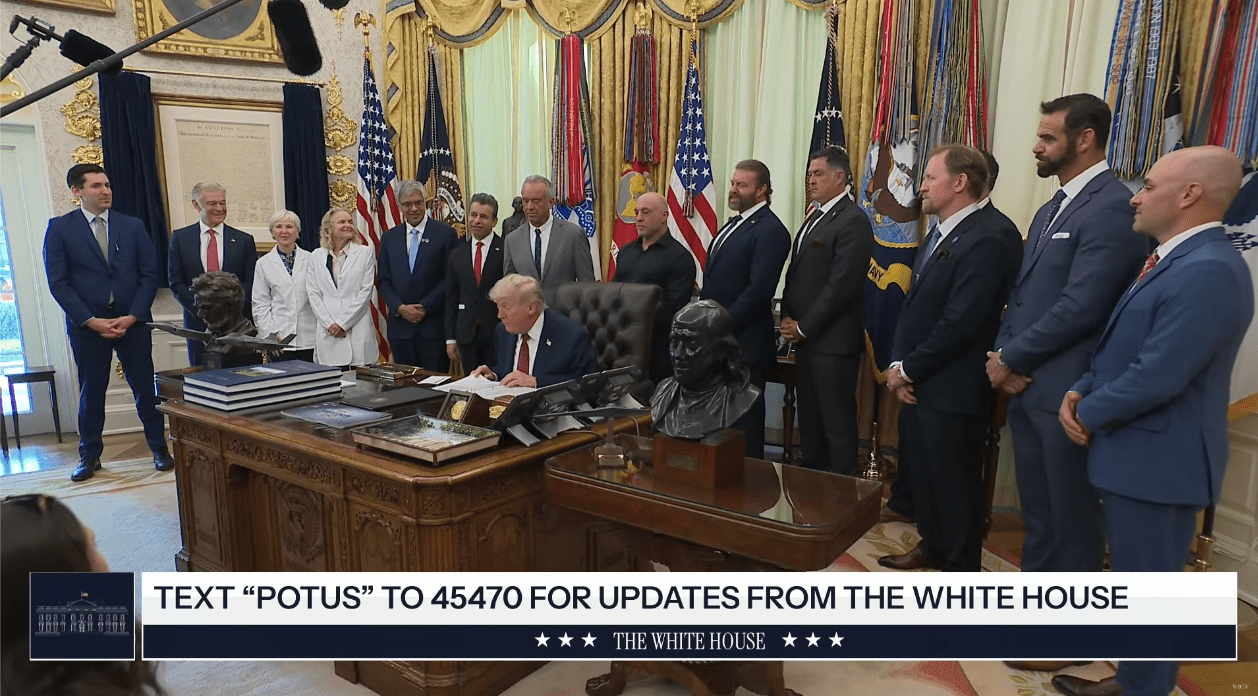
Psychedelic Alpha was first to report on the potential executive order, writing that President Trump was rumoured to be considering it, potentially motivated by an effort to repair his relationship with podcaster Joe Rogan, who has repeatedly shared his support for the ibogaine research and access. (Indeed, at the signing, Rogan stood directly behind the President.)
“There’s growing buzz this week that psychedelics (not just ibogaine) may have finally broken a political logjam in the White House”, our Editor, Josh Hardman, wrote on Thursday.
There was pushback on the idea of limiting the policy package to ibogaine, we understand, which is in many respects the most intense, and least studied, of the major psychedelic drugs. While there is substantial attention placed on ibogaine, it is by no means the sole focus.
If it were focused exclusively on ibogaine, as CBS News reported earlier this week, some might have still viewed it as a positive for the field. If the White House were willing to get behind ibogaine, with its sparse dataset and known cardiac liabilities, it could signal a more permissive attitude toward the broader class. (Other psychedelics may even look vanilla, by comparison.)
The other side of that coin, others worried, could have been a reification of a sort of ‘ibogaine exceptionalism’ that we have reported on in the past few months, whereby the drug’s often acutely challenging nature—both physiologically and psychologically—are seen as a selling point for advocates, especially when appealing to more conservative voices.
Many will welcome, then, the broader focus of today’s announcement.
Still, some would have preferred the White House to stay out of psychedelics altogether, pointing to the risk of politicising a class of drugs that already has its fair share of cultural baggage.
Others still point to last December’s marijuana rescheduling executive order as evidence that the President’s signature does not guarantee that substantive action will follow.
Whether today’s executive order and the policy direction it could signal will meaningfully politicise psychedelic research and access remains to be seen. It does seem clear, however, that Trump’s action on this topic is the product of politics.
The psychedelics field has attracted attention in the U.S. partly due to the sheer gravity of its most prominent torchbearers. The political and cultural salience of military veterans, for example, has made it difficult for the administration to shun their interest in ibogaine and psychedelics more broadly. This has manifested via legislative successes in state houses across the country, especially Republican ones. Their message has been carried by household political names like former Texas Governor Rick Perry, as well as charismatic leaders like Hubbard, both of whom can speak to, and be heard by, Republicans.
But perhaps chief among all these voices is Rogan, who had fallen out of love with the President he had previously endorsed. The podcaster had become increasingly vocal about his frustrations with Trump’s domestic and foreign policy decisions, which is presumably unhelpful during an election year. Above all else, then, today’s policy package may be the product of realpolitik, with midterm mathematics urging action on a topic that had thus far seen only words.
The Signing Ceremony
In the televised signing ceremony, it appeared that Trump had little knowledge of psychedelics, struggling to pronounce ibogaine and joking that he would like to try the drug. The President also gave a glimpse of his views on mental health disorders like depression. “If you stay busy enough, maybe that works too”, he said.
He also used that televised ceremony to try to score political points elsewhere, at one point trailing off to discuss what he views as policy wins in the area of weight loss drugs, or “the fat drug” as he calls it.
Trump’s opening comments were followed by remarks from RFK Jr., which focused on the contents of the executive order. Others, including Makary, followed.
The scope of comments by those assembled behind the President was remarkable.
Hubbard delivered a characteristically rousing speech. “Federal prohibition of psychedelic medicine in America is over”, he proclaimed triumphantly. “Everyone who has fought for this day through decades of monumental struggle, sacrifice and suffering, can now declare a seminal victory for life, liberty and the pursuit of happiness”, he went on. He also invoked ‘our brothers and sisters in Gabon’, a nod to the homeplace of the drug.
During Hubbard’s remarks, Trump sat and appeared to study the order that he was about to sign. At one point during the ibogaine advocate’s speech, the President appeared to smirk.
Rogan then jumped in to explain how today’s events came about. He says he sent the President some information about ibogaine and the scale of the opioid program in the U.S. via text message. According to Rogan, the President came back to him and said: “Sounds great. Do you want FDA approval? Let’s do it.” “It was literally that quick”, he said, as the crowd laughed.
He went on to hail the end of the Controlled Substances Act, signed into law by Richard Nixon in 1970. “For 56 years we’ve lived under those terrible conditions”, Rogan said. “We’re free of that now, thanks to all these people that we see next to me, and thanks to President Trump.”
Trump laughed, saying that Rogan is “a bit more liberal”. “Joe is an amazing guy, and he wrote about this, and I had it checked out”, the President emphasised.
Jay Bhattacharya, Director of the National Institutes of Health, chimed in to note that the research is still developing. “I do want to emphasise that this is something that we’re still studying, and we have to keep studying”, he said.
“But if it’s good, we want to get it fully approved fast”, Trump said in response. “It either works or it doesn’t”, Trump said later, after asking those behind him whether it works. “I would think there’s bee a lot of research already”, the President went on, “indirect research, maybe, the ultimate research—people that have taken it.”
Trump then went on to sign the executive order, joking as he did so: “Do you think Biden can do that?”, only adding to the political sheen of the ceremony.
During press questions, one person asked if ibogaine could be available through the VA, given it’s an expensive protocol. “We’re working that through”, Mehmet Oz, Administrator of the Centers for Medicare & Medicaid Services, said. Trump pushed him on the timing, to which Oz said a model could be prepared by the end of the year, but he was hesitant to commit to anything.
By this point, the President appeared distracted, handing out pens to Rogan, Hubbard, and the other men assembled behind him.
Later, those people joked out loud after one member of the audience assembled behind the press said that she is on multiple antidepressants that are not working for her. “We’ll get you down to Mexico”, they said.
Another question asked about the timeline for access to psychedelics. “First of all, right now, it’s available on clinical trials”, Makary responded.
“We have not had applications in-house at the FDA”, he went on, noting “there was one that came in under the Biden administration”, alluding to Resilient Pharmaceuticals’ MDMA for PTSD application. “It was kicked out and not accepted”, he said on the fate of that NDA.
“We now have three applications that are imminent, and we’ll be issuing vouchers next week”, the FDA commissioner reiterated.
Pα: This is a breaking story. We will publish further reaction from across the field in our upcoming Pα+ coverage.

Josh Hardman
Josh has been writing, talking and working on the business, science and policy of psychedelics since he launched Psychedelic Alpha in early 2020.
Join thousands of psychedelics insiders
Get the weekly psychedelic medicine briefing.
A free weekly digest covering trials, regulation, policy, and access.
By signing up, you agree to our privacy policy. You can unsubscribe at any time.