Pα+ Paywall Temporarily Lifted: This article typically sits behind our Pα+ paywall, which has been lifted for January as part of our Year in Review selection of 2025’s Top 10 articles. Join Pα+ today to read, explore, and watch everything we publish in 2026. ∎
There has been plenty of state-level psychedelic policy reform activity since our last update (see: Psychedelic Policy Push Continues: Over 60 Bills Introduced Across 22 States), with nearly thirty states now deliberating some sort of legislation since the year began.
That includes a half-dozen news states that have entered 2025 psychedelic policy reform push: last month, lawmakers in Maine, Minnesota, North Carolina, Texas, and West Virginia filed psychedelics-focused bills.
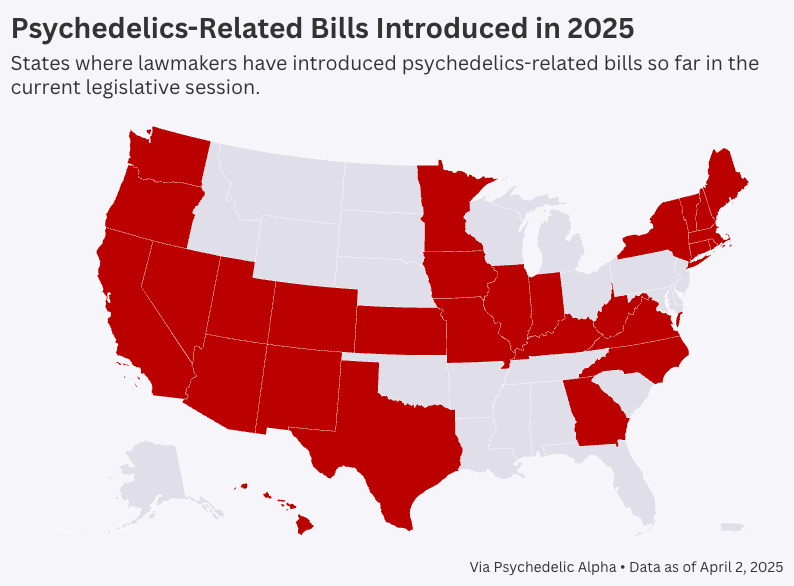
As seen in previous months (see our January and February 2025 round-ups), there is great diversity in the bills introduced. These range from additional rescheduling trigger law bills that focus narrowly on pharmaceutical forms of crystalline polymorph psilocybin (e.g., Iowa SSB 1177; West Virginia HB 3343) on the more vanilla end, right through to decriminalisation or removing criminal penalties for the possession of certain psychedelics like psilocybin (e.g., Maine LD 1034; Massachusetts S 1113; Minnesota HF 2699; Vermont S 120; Vermont H 452) on the more substantive end.
We also see bills focused on establishing pilot programs (e.g., Massachusetts HD 4509; Nevada AB 378), state-regulated systems (e.g., New Jersey A 3852), task forces and working groups (e.g., New Mexico HM 58; North Carolina SB 568; Texas SB 3005; Vermont S 106), and funding streams for psychedelic research (e.g., Texas SB 2308).
At the federal level, last week saw the introduction of the Innovative Therapies Centers of Excellence Act, which aims to carve out structure and funding for psychedelic therapies access in the VA (see: Behind the Bill: Inside a Bipartisan Effort to Bring Psychedelic Therapy to Veterans). Aside from that bill, there are many conversations happening about how the new administration can support psychedelic research and roll-out at the federal level.
Still, the vast majority of on-the-record psychedelic policy deliberation is happening in state legislatures, the focus of this update. Here, Psychedelic Alpha’s Noah Smith and Josh Hardman present a state-by-state, bill-by-bill round-up of psychedelics-focused bills introduced in March.
Editor’s note: Later this week, we will publish a review of major updates on the psychedelic bills introduced thus far this year.
Georgia
HB 717: Regulates the Provision of FDA-Approved Psychedelic-Assisted Treatments
This bill, introduced by a bipartisan suite of state Representatives, would amend Georgia law to allow psychedelic-assisted treatment and therapy to be provided by certain licensed healthcare professionals, once FDA approved.
HB 717 envisages the creation of a Board which would be tasked with establishing rules and regulations to govern the administration of psychedelic-assisted treatment in clinics by the end of 2025. The Bill identifies physicians (general), anaesthesia assistants, and certified RN anaesthetists as those professionals who are appropriate to oversee and/or deliver such treatments.
Once the Board has arrived at its rules and recommendations, licenses will be issued from July 1, 2026, according to the Bill’s current text, with applications for licensure reviewed by the Board.
While the Bill discusses “psychedelic-assisted treatment”, the scope of drugs included within its provisions is limited to those that are FDA-approved. For now, then, that only includes ketamine, but there would be room for expansion to other agents once approved.
Hawaii
SB 1042: Establishes the Mental Health Emerging Therapies Pilot Program
Introduced by Hawaii Senator Stanley Chang (D), this bill would establish a 2-year Mental Health Emerging Therapies Pilot Program that would aim to generate a public-private partnership to fund Phase 3 trials of candidates that hold FDA Breakthrough Therapy Designations, including psychedelics.
The bill was originally introduced in January, but we regrettably neglected to include it in an earlier write-up. It has since passed the Senate and is now making its way through the House.
Iowa
SSB 1177: Replaces HF 14, Compass-Backed Crystalline Polymorph Psilocybin Rescheduling Trigger Law
This is another Compass Pathways-backed rescheduling trigger law bill that aims to automatically reschedule an FDA-approved and federally rescheduled medicine containing crystalline polymorph psilocybin at the state level.
This bill replaces HF 14, which we covered in an earlier review.
HF 978: Replaces HF 620, Creates State-Legal System for Psilocybin’s Use in PTSD
HF 620, which we discussed in our February policy round-up, has been replaced by HF 978.
Maine
LD 1034: Decriminalises Psilocybin Possession
Introduced by Representative Grayson Lookner (D) and co-sponsored by a bipartisan set of lawmakers, this bill would amend state law to effectively decriminalise the personal possession of one ounce or less of psilocybin among adults.
The bill has been carried over, meaning it will not be deliberated upon in the current legislative session.
Massachusetts
Note: We have covered each of these bills previously when they were docketed. Now, they have bill numbers, so we provide a brief update on those associated numbers.
HD 4509: Assigned Bill Number: Authorises Psychedelics Pilot Program
Introduced by Jim O’Day (D), this bill directs the state’s Department of Public Health to establish a pilot program for psychedelic-based mental health treatments.
Licences would be provided to no more than three clinics. The program would be geared towards building an evidence base with which to design clinical protocols and regulatory frameworks that ensure safe use.
S 1400 is the Senate version of the bill.
We covered this bill in our January policy round-up, when it was docketed as SD 1624.
S 1113: Assigned a Bill Number: Removes Criminal Penalties for Limited Psilocybin Possession
This bill, introduced by Cindy Friedman (D), would remove criminal penalties for posession of one gram or less of psilocybin and psilocin, “excluding the weight of any material such as water, fungal material, or other substances of which the controlled substance is a part or to which it is added, dissolved, held in solution, or suspended”. Instead of criminal penalties, such possession would be punished with a civil penalty of $100 and confiscation of the substance.
What’s more, a whole host of individuals are exempted from the civil penalty and forfeiture. Those include veterans, first responders, individuals with certain documented health conditions, Indigenous people using psilocybin or psilocin for ceremonial or traditional reasons, healthcare professionals working with or studying psychedelics, and so on.
Those under the age of 21 would be required to complete a drug awareness program and 10 hours of community service within one year, or else receive a $1,000 civil penalty, to which parents or legal guardians have joint liability.
We covered this bill in our January round-up, when it was assigned a Senate Docket number 9SD 1624).
H 1858 is the House version of the bill.
H 1726: Assigned Bill Number: Allows for Dismissal of Certain Criminal Complaints Relating to Psilocybin
We covered this bill in our February policy round-up, when it was docketed as HD 3895.
H 1624: Assigned Bill Number: Establishing a Psychedelic Task Force
We originally covered this bill in our January bill-by-bill round-up, when it was docketed as HD 4243.
S 1538: Assigned Bill Number: Connecting Veterans with ‘Breakthrough Treatments’
Introduced by Dylan Fernandes (D), we originally covered this bill in our January write-up when it was assigned Senate Docket number 323 (i.e., SD 323). It is now S 1538, working its way through the Senate.
H 2506: Assigned Bill Number: Decriminalisation of Psilocybin as a Treatment for PTSD and Other Qualifying Conditions
We originally covered this bill in our February round-up, when it was assigned a House Docket number (HD 3368).
H 2203: Assigned a Bill Number: Establishing a Pilot Program for Psilocybin Access
We originally covered this bill in our January write-up, when it was assigned House Docket number 4196.
H 2532: Assigned Bill Number: Therapeutic Psilocybin Treatment Centers
This bill, introduced by Lindsay Sabadosa (D), would establish a 5-site pilot program whereby eligible non-profit centers offer psilocybin treatment for various health conditions. We originally covered it in our January write-up, when it was assigned House Docket number 4017 (i.e., HD 4017).
Minnesota
HF 2699: Removes Criminal and Civil Penalties for Personal Use and Possession of Psilocybin, with Specifics to Be Decided Upon by a Board
This Bill, introduced by Representative Andy Smith (D) and co-sponsored by a suite of Democrats, would eliminate criminal and civil penalties for personal use and possession of psilocybin by adults 21 years and older. As with other decrim-type bills, it would not allow for commercial sale or distribution. Instead, it allows for personal cultivation (at one’s primary residence), transportation, possession, and non-remunerative exchange.
The Bill also states that no landlord may refuse to leave or evict someone for cultivating or possessing psilocybin, nor can someone be denied custody, visitation, or parenting time for possession/cultivation.
People under 21 who violate such provisions are guilty of a petty misdemeanour, with a fine of no more than $100.
The specific limits on possession would be determined by the Psychedelic Medicine Board, established by this Bill, but would not exceed a one-year supply. The Board could also recommend other regulations or requirements.
HF 2699 also states that the Commissioner of Health must develop a public education program on the responsible use of psilocybin, harm reduction, potential risks, and so on, and develop and offer training to first responders to help them handle situations involving psilocybin ingestion. The Bill also establishes grants for community outreach programs.
HF 2906: Establishes State-Regulated Therapeutic Psilocybin System
Also introduced by Andy Smith and co-sponsored by several of the same Democrats as HF 2699, this bill would establish a legal, regulated system for the ‘therapeutic use’ of psilocybin in adults diagnosed with a qualifying medical condition that meet certain requirements.
In order to participate in the system, individuals must apply to become a registered patient with the commissioner and engage in an informed consent process. If successful, the individual would be issued a card “that permits the registered patient to cultivate, possess, transport, and use psilocybin”, in an arrangement somewhat reminiscent of medical marijuana programs.
Aside from the permitted activities for registered patients, registered facilitators “must be physically present with a registered patient during an administration session”. In order to become a registered facilitator, one must demonstrate competency in ethics, safe use of psilocybin, and so on, with the specifics to be decided by the commissioner.
Nevada
AB 378: Establishes a Psychedelic Therapy Pilot Program for Veterans, Former First Responders
Introduced by a group of eight bipartisan Representatives, this Bill would create the Alternative Therapy Pilot Program, whereby an ‘alternative therapy’ is a treatment for a patient with a mental health condition “ that involves administering to the patient, under medical supervision and control, a psychedelic substance.”
The psychedelics mentioned in the Bill are psilocybin, psilocin, dimethyltryptamine, ibogaine and mescaline, while mental health conditions include—but are not limited to—PTSD, depression, and anxiety disorders.
The pilot program would provide qualifying patients with access to psychedelic-based treatments via experimental and investigational pilot clinic programs. The drugs would be provided under the supervision of an approved practitioner, at medical facilities or approved locations, to patients who are over the age of 21, diagnosed with a mental condition, and are ‘honourably discharged’ veterans or were previously first responders.
New Mexico
HM 58: Calls on State to Study Implementation of a Regulated Psilocybin System
This bill, introduced by Representative Dayan Hochman-Vigil (D), requests that the Department of Health study psilocybin-based treatment and its potential implementation.
The bill lists many focus areas of such a study, from the standardisation of training requirements and testing of psilocybin-containing substances through to regulatory and legal barriers to such treatments and frameworks for their implementation in the state.
North Carolina
SB 568: Task Force to Consider Pathways to Psychedelic Medicine Access
Introduced by Senators Sophia Chitlik (D) and Bobby Hanig (R), this Bill would establish a mental health and psychedelic medicine task force in the state.
The task force would consider the barriers to the implementation of psychedelic medicines in the state and recommend licensing and insurance requirements for practitioners in the event of FDA approval. It would also consider other pathways to the legalisation of psychedelics in North Carolina. It would submit a final report to the General Assembly by December 1st 2026.
Texas
SB 3005: Commissions a Desk-Based Study Into Psychedelics for PTSD, Depression
Introduced by Senator César Blanco (D), this bill would instruct the Department of State Health Services to conduct a study in consultation with the Baylor College of Medicine and the Center for Psychedelic Research and Therapy at Dell Medical School at UT Austin. That study would investigate the use of psychedelic therapies for PTSD, depression, “and other co-occurring conditions.”
As seen in other bills, the study would be desk-based, with those involved tasked with reviewing clinical trials, the broader literature, and so on; as opposed to conducting an interventional study. It would require the Department to submit a report by December 1, 2026.
The House version of the bill, HB 4014, is sponsored by Representative John Bucy (D).
SB 2308: Creates a Fund to Support Ibogaine Drug Development
This Bill, introduced by Senator Tan Parker (R), would establish a grant program to support FDA-approval-aligned drug development of ibogaine treatment for opioid use disorder (OUD), co-occurring substance use disorder, “and any other neurological or mental health conditions for which ibogaine demonstrates efficacy.”
The House version of the bill, HB 3717, is sponsored by Representative Cody Harris (R).
Vermont
S 120: Removes Criminal Penalties for Personal Possession of Certain Drugs, Funds Support/Education Program
This Bill, introduced by Senator Tanya Vyhovsky (D), would create the Drug Use Health and Safety Advisory Board to determine benchmark levels of supply (by January 1, 2026) for each regulated drug under discussion, with the goal of reducing or preventing criminalisation.
The Bill discusses many such drugs, but includes psychedelics like LSD, MDMA, other ‘hallucinogenic drugs’. It would also eliminate criminal and civil penalties for those drugs it encompasses at the quantities it arrives at. According to the Bill, people caught in possession of drugs under the benchmark would be offered comprehensive health needs screening, which—if completed—could get a gift card with a retail value of up to $50.
S 106: Renews the Vermont Psychedelic Therapy Working Group
This bill, sponsored by Senator Martine Gulick (D), would renew the state’s Psychedelic Therapy Advisory Working Group until January 1, 2026.
H 452: Decriminalises Psilocybin-Containing Mushrooms, Establishes Therapeutic Consultation Program
Introduced by Representative Brian Cina (D), this bill would decriminalise the possession, cultivation and noncommercial personal use of psilocybin-containing mushrooms by adults. It would also establish the ‘Psilocybin Therapeutic Consultation Program’, which would be a state-licensed system.
West Virginia
Two psychedelics-focused bills have been introduced in West Virginia since our last update. Both have made swift progress through the House and now face the Senate.
HB 3344: Creates a Fund to Support Ibogaine Drug Development
This bill, introduced by Delegate Evan Worrell (R), would establish a grant program to fund clinical trials of ibogaine with the goal of FDA approval. The bill is very similar to SB 2308 in Texas.
The bill has passed the House and is now making its way through the Senate.
HB 3343: Crystalline Polymorph Psilocybin Rescheduling Trigger Law
Also introduced by Worrell, this bill is another Compass Pathways-backed crystalline polymorph psilocybin rescheduling trigger law bill.
The bill has passed the House and is now making its way through the Senate.