A weekly round-up of the
latest coverage in psychedelics.
Receive the free weekly digest straight to your inbox every week
By signing up, you agree to our privacy policy. You can
unsubscribe at any time.
September 22 – 28, 2025
A Note from the Editor
I write this short note from Stockholm, Sweden, where the fantastic Borealis Summit just wrapped.
I gave a talk that provided an update of sorts on the psychedelic drug development pipeline as well as policy developments from around the world. It was among the driest topics, truth be told, with others exploring themes as rich as consciousness and meaning-making, challenging experiences, and gender and psychedelics.
As a Brit myself, I am very pleased to have reason to attend events and cover stories much closer to home, with Europe catching up with its North American counterparts in terms of psychedelic policy reform efforts, government-funded research, and so on. The continent, and the Nordics, are making their mark on the so-called psychedelic renaissance.
Elsewhere this week, we published a very long Issue of the Psychedelic Bulletin, which covers a whole host of topics: from atai Life Sciences’ $11.4M NIDA grant and Reunion Neuroscience’s $133M upsized Series A financing to a payor-backed psilocybin pilot program in Australia and real-world outcomes data from Oregon’s psilocybin services.
In the press, a New York Timesfeature has caused quite a stir. It details the story of venture capitalist Amy Griffin, whose immensely popular book, “The Tell”, recounts her story of recovering what she describes as a memory of sexual assault by a teacher during her childhood. The apparent memory was recovered, Griffin says, during an underground MDMA therapy experience. (Griffin was connected to the MDMA therapists via MAPS founder Rick Doblin. Her husband is a MAPS donor, and the pair invested in Lykos Therapeutics via their foundation.) The Times piece probes Griffin’s account and presents several questions that the book, and its popularity, raise. The case also draws focus on questions around psychedelic-induced recovered memories, which is quite a sensitive matter. During my time in Stockholm, I spoke to an expert on this topic; the interview will be published soon.
Anyhow, without further ado: Here’s your Psychedelic News Feed, a one-stop digest for the latest coverage of psychedelics business, policy, research and beyond.
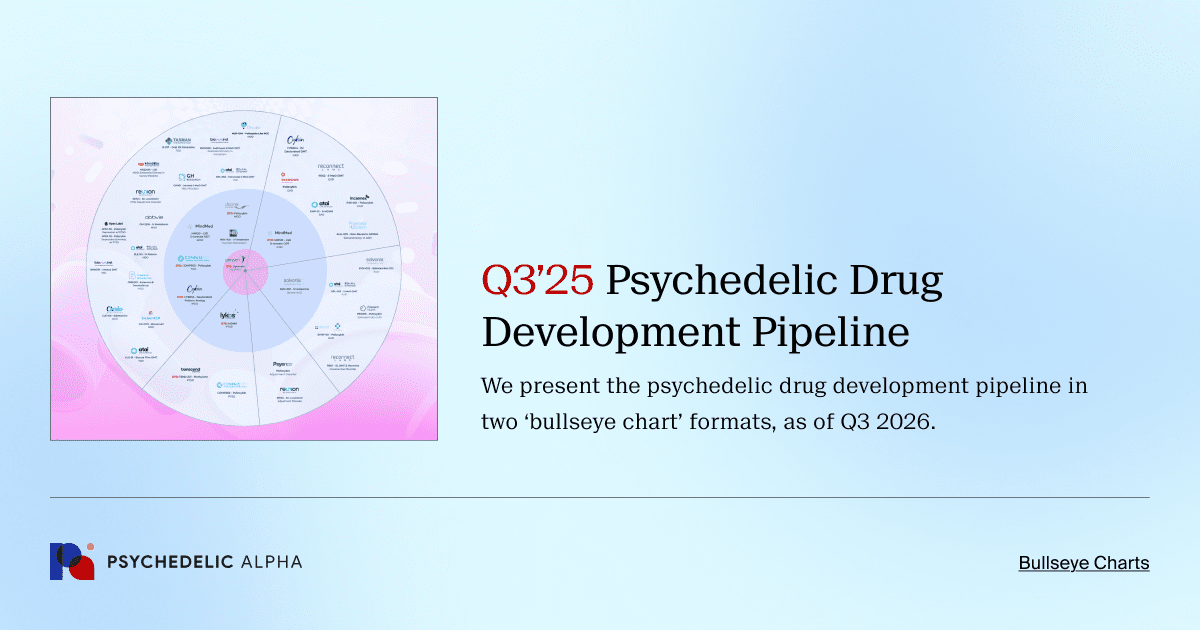
Welcome to the hundreds of new subscribers who have joined us after exploring the latest versions of our signature Psychedelic Drug Development Tracker visualisations, which were published last week.
The timing of those fresh Bullseye Charts was, in hindsight, quite opportune, as it was a relatively quiet week… for psychedelics, at least.
Other than a few media mentions, the only real news that broke was the UK Royal College of Psychiatrists’ new position paper and guidance booklet on the use of ‘psychedelic and related substances’, as they choose to refer to them. We covered both publications when they were made available on Friday morning.
Early next week, we will publish another bumper Issue of the Psychedelic Bulletin and a look at MindMed’s Phase 2b study of LSD for generalised anxiety disorder. Subscribe to Pα+ today to make sure you receive all of our Bulletins and articles. (More info / join here; or, reply to this email to discuss group/corporate plans.)
Anyhow, without further ado: Here’s your Psychedelic News Feed, a one-stop digest for the latest coverage of psychedelics business, policy, research and beyond.
This week has been a little quieter, as the dust began to settle following the FDA’s publication of the Complete Response Letter it sent to Lykos Therapeutics last August, when it declined to approve its MDMA for PTSD new drug application. On Monday, we published a deep dive into the CRL’s contents, reactions from the field, and what it might mean for Lykos’ path to approval.
On Thursday, we shared a conversation I had with former EMA scientific expert Dr. Florence Butlen-Ducuing, where we discussed Europe’s psychedelic renaissance.
Elsewhere, both the LA Times and Wired ran stories on how athletes are turning to psychedelics, including ibogaine, to address brain injuries. And, STATreports that psychedelics “are suddenly drawing interest from big drugmakers”, in a story that I was pleased to appear in.
Anyhow, without further ado: Here’s your Psychedelic News Feed, a one-stop digest for the latest coverage of psychedelics business, policy, research and beyond.
This week looked set to be much quieter, with no real news to speak of for the first half, aside from Cybin’sousting of its CEO, Doug Drysdale.
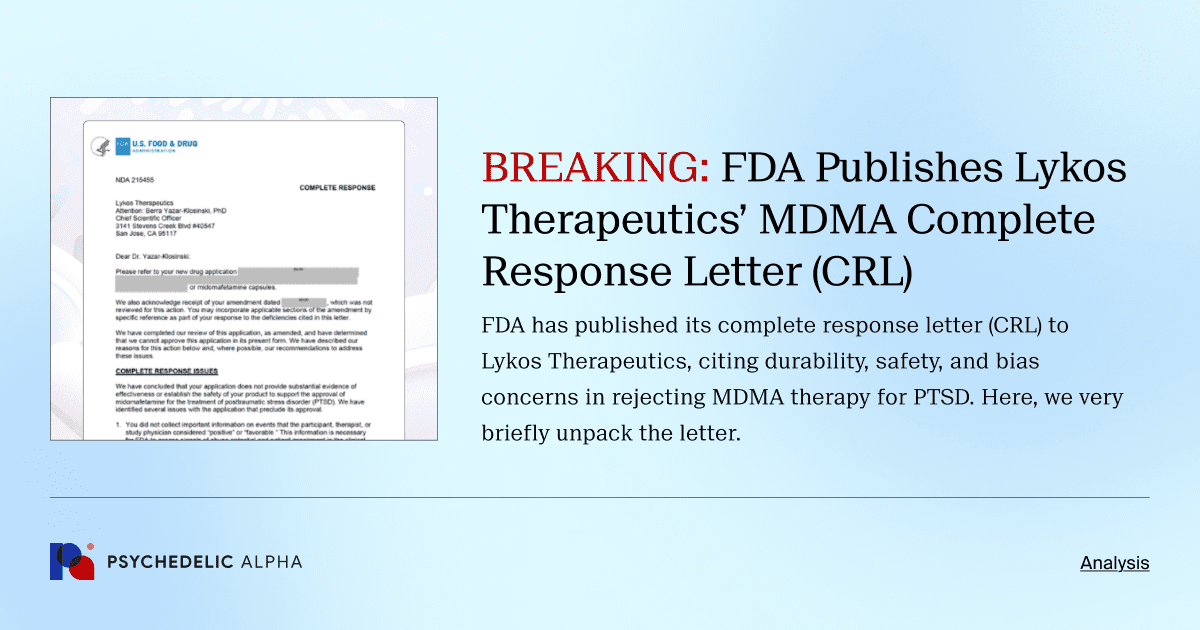
Then, on Thursday, our eagle-eyed Medical Advisor, Michael Haichin, noticed the FDA had released 89 previously unpublished complete response letters (CRLs) that it has issued to sponsors since 2024.
Among them was the letter it sent to Lykos Therapeutics last August, when it rejected its MDMA for PTSD new drug application. We broke the news on Thursday morning and will share a little more detail with our Pα+subscribers on Monday.
Given that we were anticipating a quieter week (read: we tempted fate!), we used Bulletin 208 to look back at two conversations that took place at Psychedelic Science in June. One was an on-stage discussion between psychedelic drug development execs, while the other was a chat that I had with APA Division 56 President Jessica Punzo.
Anyhow, without further ado: Here’s your Psychedelic News Feed, a one-stop digest for the latest coverage of psychedelics business, policy, research and beyond.
Teams, groups and corporate pricing plans are available, please get in touch via email to learn more.
Benefits
Front-row access to the psychedelics space: breaking bulletins, in-depth articles, insider interviews and sharp analysis of the moments that matter—from major trial results and funding rounds to policy shifts shaping the future. Plus, full access to our complete archive and Library.
Independent data-driven reporting, analysis and commentary on the psychedelics space: from business and drug development through to policy reform and research.
Aside from group pricing, we also offer bespoke reports and regular briefings. Get in touch to discuss.
Subscribe to our
free newsletter
By signing up, you agree to our privacy policy. You can
unsubscribe at any time.
Manage Consent
To provide the best experience, we use technologies like cookies to store and/or access device information. Consenting to these technologies will allow us to process data such as browsing behaviour or unique IDs on this site. Not consenting or withdrawing consent may adversely affect certain features and functions.
Functional
Always active
The technical storage or access is strictly necessary for the legitimate purpose of enabling the use of a specific service explicitly requested by the subscriber or user, or for the sole purpose of carrying out the transmission of a communication over an electronic communications network.
Preferences
The technical storage or access is necessary for the legitimate purpose of storing preferences that are not requested by the subscriber or user.
Statistics
The technical storage or access that is used exclusively for statistical purposes.The technical storage or access that is used exclusively for anonymous statistical purposes. Without a subpoena, voluntary compliance on the part of your Internet Service Provider, or additional records from a third party, information stored or retrieved for this purpose alone cannot usually be used to identify you.
Marketing
The technical storage or access is required to create user profiles to send advertising, or to track the user on a website or across several websites for similar marketing purposes.